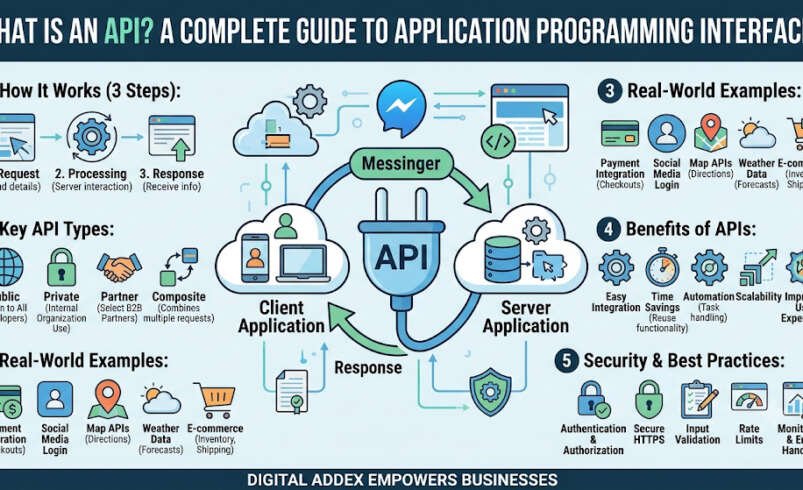

What is an Api? An API (Application Programming Interface) is a technology that allows different software applications, websites, and systems to communicate and exchange information with each other. APIs are a crucial component in today’s web development landscape, enabling developers to integrate external services, share data, and connect applications more easily without having to develop each feature from the ground up.
APIs are now becoming a common feature in online platforms, apps, eCommerce sites, payment methods, and cloud services. They can enhance functionality, automate processes, and provide improved digital experiences for businesses.
What Is an API and How Does It Work?
API is a middleman in two software apps. It enables one application to call specific information or services from another application in accordance with a set of rules.
For instance, if you were to go visit a weather website, it might call some external weather service to get the current temperature, humidity, and forecast data.
The API process, in general, has three steps:
Request: An application sends a request to an API for specific information or an action.
Processing: The API receives the request and interacts with the appropriate server or service.
Response: Backs the requested information or indicates that the action was performed.
The data is transmitted via HTTP/HTTPS and is often exchanged in the form of JSON or XML.
Types of APIs
APIs can be classified based on their accessibility and functionality. They come in a variety of forms, such as:
Public APIs: These APIs are provided to external developers and businesses. They enable third-party apps to reach a certain service or information.
2. Private APIs: Private APIs can be used internally within an organization. They enable secure data sharing between various departments and internal systems.
3. Partner APIs: These APIs are made available to select business partners to enable integration and enhance partnership working.
4. Composite APIs: These are APIs which fuse multiple requests into one to provide information from various services efficiently to the applications.
Common API Examples
APIs are used in many things in digital everyday life. Examples include:
Payment Integration: The payment APIs enable websites to use payment gateways for online payments.
Social Media Login: APIs allow the user to log in to applications through their social media accounts.
Map APIs: Google Maps Integration supports websites to show locations, directions and geographical information.
Weather Applications: Weather APIs give current weather predictions and environmental data.
Ecommerce Websites: APIs integrate ecommerce websites with inventory management, shipping, and payment solutions.
Benefits of Using APIs
APIs offer a number of benefits to both businesses and developers:
Easy Integration: Integrate with other applications and third party services.
Time Savings: Reduce development time by using existing functionalities.
Automation: send and receive information and handle tasks automatically.
Scalability: Introduce new features and services to accommodate the growing needs of the business.
Improved User Experience: Deliver connected and convenient digital experiences.
Greater Efficiency: Minimize repetitive development and facilitate communication among systems.
API Security and Best Practices
To secure sensitive data and prevent unauthorized access, API security is crucial. Authors should implement authentication and authorization, secure HTTPS connections, validation of input data and use proper rate limits.
Setting up regular API monitoring, implementing proper error handling procedures, and keeping API documentation updated also contribute to the reliability and security of integrations.
Conclusion
APIs are integral to every software and web development today. It allows applications to communicate and exchange data and be integrated with powerful features, without having to build everything from scratch. APIs enhance digital services by enabling them to be more connected and efficient, from online payments to social media integration. By leveraging cutting-edge web development technologies and integrating the proven Digitaladdex features, Digital Addex empowers businesses to create websites that are both functional, scalable, and user-friendly.