

Why Choosing the Right Commercial RO Plant Manufacturer Matters More Than You Think
Water is one of those resources businesses take for granted — until it becomes a problem. Whether you’re running a food processing unit, a pharmaceutical facility, a hotel, or a manufacturing plant, water quality directly impacts your operations, equipment lifespan, and even your bottom line. This is where the role of a commercial RO plant manufacturer becomes critical.
Reverse Osmosis (RO) technology has become the gold standard for industrial and commercial water purification. But not every RO system — or every manufacturer — delivers the same value. In this post, we’ll break down what commercial RO plants actually do, why manufacturer selection matters so much, and what businesses should look for before investing.
What Is a Commercial RO Plant?
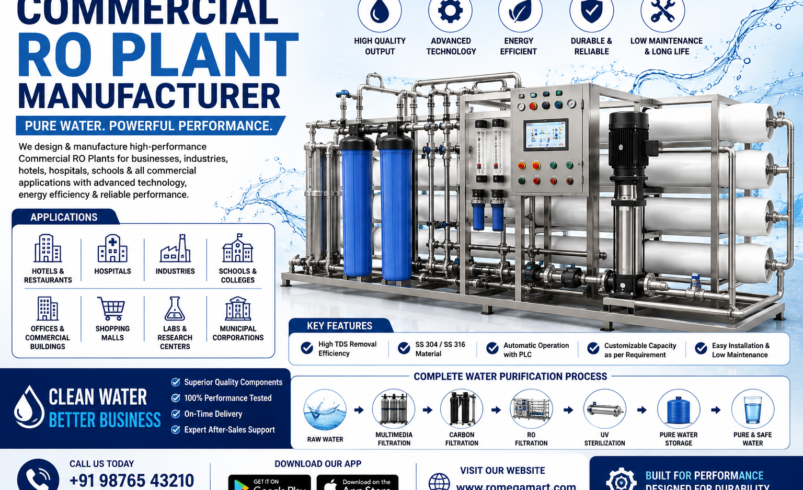
A commercial RO plant is a large-scale water purification system designed to remove dissolved salts, heavy metals, bacteria, and other contaminants from water using semi-permeable membrane technology. Unlike residential RO units, commercial systems are built to handle significantly higher water volumes — often ranging from a few hundred liters per hour to several thousand liters per hour, depending on the scale of operations.
These systems are widely used across industries such as:
- Food and beverage processing
- Pharmaceutical manufacturing
- Textile and dyeing units
- Hotels and hospitality
- Packaged drinking water production
- Power plants and manufacturing facilities
Each industry has different water quality requirements, which means commercial RO systems often need to be customized rather than sold as one-size-fits-all solutions.
Why the Manufacturer You Choose Makes a Bigger Difference Than You’d Expect
It’s tempting to think of an RO plant as just another piece of equipment — install it, and the problem is solved. But that mindset often leads to costly mistakes down the road. Here’s why manufacturer selection matters so much.
1. Engineering Quality Determines Long-Term Performance
Two RO plants can look identical on paper — same capacity, same specifications — yet perform very differently in real-world conditions. This comes down to engineering quality: membrane selection, pressure vessel design, pre-treatment systems, and automation controls.
A reputable commercial RO plant manufacturer doesn’t just assemble components; they engineer systems that account for your specific water source, contamination levels, and operational demands.
2. Customization Isn’t Optional — It’s Essential
Borewell water, municipal water, and surface water all carry different contamination profiles. A manufacturer who offers only standardized systems without proper water testing and customization is setting you up for inefficiency — or worse, system failure within months.
Good manufacturers begin with a detailed water analysis before recommending plant capacity, membrane type, and pre-treatment requirements.
3. After-Sales Support Can Make or Break Your Investment
RO plants are not “install and forget” systems. Membranes need periodic replacement, sensors require calibration, and systems need routine maintenance to perform efficiently. Choosing a manufacturer with weak after-sales service often means costly downtime and repeated repair expenses.
Before finalizing a manufacturer, businesses should ask:
- Do they offer on-site maintenance support?
- Is spare part availability guaranteed?
- What’s their average response time for service requests?
- Do they provide operator training?
4. Compliance and Certification Matter
Industries like pharmaceuticals and food processing operate under strict regulatory frameworks. Your RO plant manufacturer should be well-versed in relevant compliance standards and capable of providing documentation needed for audits and certifications.
Common Mistakes Businesses Make When Choosing an RO Plant Manufacturer
Even experienced facility managers sometimes fall into these traps:
Choosing based on price alone — The cheapest quote often means compromised membrane quality or missing components that get added as “extras” later.
Ignoring water testing — Skipping proper water analysis leads to undersized or mismatched systems that struggle under real operating conditions.
Overlooking scalability — A plant that meets today’s needs but can’t scale with business growth becomes a costly bottleneck within a few years.
Not verifying manufacturer experience — Newer manufacturers may offer lower prices but often lack the field experience to handle unexpected operational challenges.
What to Look for in a Reliable Commercial RO Plant Manufacturer
If you’re currently evaluating manufacturers, here’s a practical checklist to guide your decision:
- Industry experience — How many years have they been manufacturing commercial systems, and in which industries?
- Customization capability — Can they design systems based on your specific water source and usage requirements?
- Component quality — What brands of membranes, pumps, and controllers do they use?
- Installation support — Do they handle end-to-end installation, or just supply equipment?
- Maintenance contracts — Are annual maintenance contracts (AMC) available?
- Client references — Can they share case studies or references from similar industries?
Taking the time to evaluate these factors upfront saves significant costs and operational headaches later.
The Growing Demand for Commercial RO Plants
As industries scale and water quality regulations tighten, demand for reliable commercial RO systems continues to grow. Businesses are no longer treating water purification as an afterthought — it’s becoming a core part of operational planning, especially in water-stressed regions.
This growing demand has also led to increased competition among manufacturers, which is good news for buyers — but only if they know how to separate genuinely capable manufacturers from those cutting corners to offer lower prices.
Final Thoughts
A commercial RO plant is a long-term investment, not just an equipment purchase. The right manufacturer will treat it that way too — starting with proper water analysis, offering customized system design, and standing behind their product with reliable after-sales support.
Before signing any contract, take the time to ask the right questions, request references, and understand exactly what you’re paying for. In the long run, the manufacturer you choose will impact not just your water quality, but your operational efficiency, compliance standing, and overall business costs.
Investing a little extra time in this decision today can save your business from expensive water-related problems tomorrow.