

Water is no longer just a basic resource for industries—it is an essential part of manufacturing, processing, cleaning, cooling, and many other operations. As industries become more conscious about water quality and reuse, advanced purification systems are becoming increasingly important. Among these technologies, Reverse Osmosis has established itself as a practical solution for treating water at different scales.
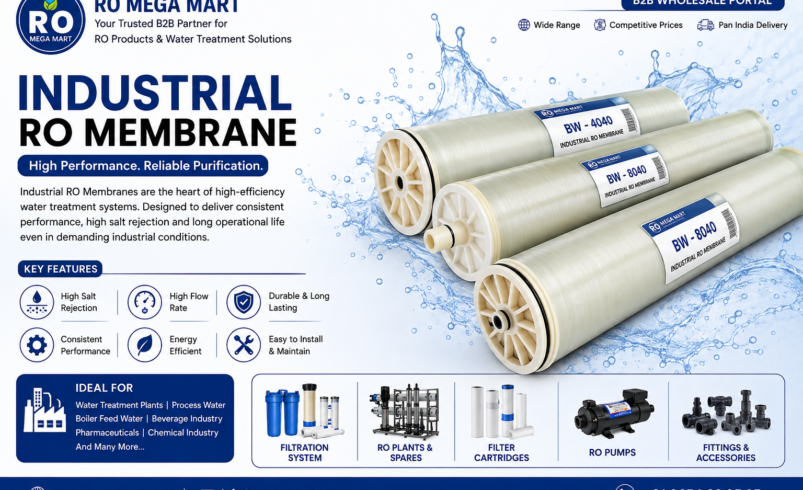
At the heart of a commercial or industrial RO system is the Industrial RO Membrane. It is the component that performs the primary separation in the Reverse Osmosis process and plays a major role in determining the quality and quantity of treated water.
But an Industrial RO Membrane is not simply another spare part. Its performance is connected to the complete RO system—feed-water quality, pretreatment, pressure, temperature, recovery, maintenance, and operating practices all have an impact on how effectively the membrane performs.
For businesses working with water treatment, understanding the role of an Industrial RO Membrane can help in making better purchasing, installation, and maintenance decisions.
Why Industrial Water Treatment Needs a Different Approach
The water requirements of an industrial facility can be very different from those of a household. A factory may require hundreds, thousands, or even much larger quantities of treated water depending on its operations.
Manufacturing processes can generate water containing dissolved salts, suspended matter, organic substances, hardness, and other unwanted components. In some applications, treated water may be required for production, boiler feed, rinsing, processing, or reuse.
This is where an industrial RO system becomes valuable.
Instead of relying on a single filtration stage, industrial water treatment generally combines multiple processes. Pretreatment prepares the incoming water, while the RO membrane performs a more advanced separation of dissolved substances. Additional polishing or treatment stages can then be used depending on the final application.
The Industrial RO Membrane therefore sits at a critical point in this process.
The Role of an Industrial RO Membrane
Reverse Osmosis works by using pressure to move water through a semi-permeable membrane. The membrane allows a portion of the water to pass through while restricting many dissolved substances.
The treated water leaving the membrane is commonly referred to as permeate, while the concentrated stream is called reject or concentrate.
The actual performance of an Industrial RO Membrane depends on several operating conditions. Two systems using similar membranes can produce different results if their feed water, pressure, temperature, pretreatment, or recovery levels are different.
This is why choosing a membrane should always be connected to the requirements of the RO plant rather than based on price alone.
More Than Just Purification
One of the interesting aspects of industrial RO is that the membrane does more than simply “filter” water.
Traditional filters are generally designed to capture particles based on size. Reverse Osmosis involves a different separation mechanism and can significantly reduce dissolved solids and many other substances from water.
For an industrial facility, this can have a wider impact.
Better-treated water can support process requirements, reduce the load on downstream equipment, and make water reuse more practical in suitable applications. The exact results, however, depend on the feed water and complete system design.
This is why an Industrial RO Membrane should be viewed as part of a larger treatment strategy rather than an isolated component.
Where Industrial RO Membranes Fit Into the Business World
Industrial RO technology is used across a wide variety of sectors. The exact design of each system may differ, but the requirement for controlled water quality is a common factor.
Industries and facilities that may use industrial RO systems include:
- Manufacturing facilities
- Food and beverage operations
- Pharmaceutical facilities
- Textile industries
- Hotels and commercial establishments
- Water treatment companies
- Industrial process-water plants
- Commercial water purification facilities
- Boiler-feed water applications
- Water reuse projects
In each case, the membrane selection needs to match the particular water-treatment objective.
For example, a system designed for process water may have different requirements from one designed for general commercial water treatment. Similarly, a high-TDS feed-water application may require a different approach from a relatively low-TDS source.
The Business Side of Industrial RO Membranes
There is another side to Industrial RO Membranes that is often overlooked: sourcing.
For a water treatment dealer or service provider, a membrane is not only a technical component. It is also a business inventory item.
Dealers need products that customers actually require. Technicians need replacement components when servicing systems. Distributors need dependable product availability. Water treatment companies may need several components for new projects.
This creates demand for a marketplace where businesses can explore different RO products without having to manage every requirement through separate suppliers.
That is where RO Mega Mart can become a useful sourcing platform for the RO and water treatment industry.
Why Product Availability Matters
Imagine a technician has received an urgent service requirement for an industrial RO plant. The problem has been identified, but the required membrane is not readily available.
The technical knowledge may be there. The customer may be ready. The service team may be prepared.
But without the required component, the project can still be delayed.
For this reason, product availability is an important part of the water treatment supply chain.
A business that regularly deals in RO systems may need membranes, filter housings, pumps, cartridges, fittings, valves, dosing-related components, and other parts. Having access to a broad product range can make procurement more convenient.
Industrial RO Membrane and System Performance
A membrane’s performance cannot be judged only by looking at the product itself.
The surrounding system matters.
If feed water contains high levels of suspended particles and the pretreatment system is inadequate, the membrane can face excessive fouling. If hardness and scaling potential are not managed properly, scaling may affect performance. Incorrect operating conditions can also influence membrane output.
This means that a good Industrial RO Membrane works best when supported by a properly designed system.
It is similar to an engine: the engine is important, but fuel quality, lubrication, cooling, and maintenance also influence overall performance.
The same principle applies to RO plants.
The Importance of Pretreatment
Before water reaches an RO membrane, it may pass through several pretreatment stages.
Depending on the source-water characteristics, a system may use:
- Sediment filtration
- Activated carbon filtration
- Water softening
- Cartridge filtration
- Antiscalant treatment
- Iron or manganese removal
- Other specialized pretreatment
The exact combination depends on the feed water.
Pretreatment helps reduce the substances that could negatively affect the RO membrane. This is particularly important in industrial applications because the membrane may be expected to operate for extended periods under demanding conditions.
A membrane should not be expected to compensate for poor pretreatment.
Selecting an Industrial RO Membrane for a Real Application
When businesses search for an Industrial RO Membrane, they often begin with the product name. However, a better starting point is the application.
Questions worth considering include:
What is the feed-water source?
Borewell water, municipal water, surface water, and process water can have very different characteristics.
What is the feed-water TDS?
The dissolved-solids level influences membrane selection and system design.
What capacity is required?
The required permeate flow affects the number and configuration of membrane elements.
What is the operating pressure?
Different systems operate under different pressure conditions.
What recovery is expected?
The desired recovery level can influence system design and membrane operating conditions.
What is the required treated-water quality?
The final application determines how much treatment is needed.
These questions help businesses move from simply “buying a membrane” to selecting a product appropriate for their actual system.
Industrial RO Membrane Replacement
Even a well-maintained membrane does not last forever.
Over time, performance can change due to operating conditions, fouling, scaling, chemical exposure, cleaning frequency, feed-water changes, and normal aging.
A replacement decision should ideally be based on system performance rather than an arbitrary schedule.
Common signs that a membrane may require attention include changes in permeate flow, changes in rejection performance, increased pressure requirements, or other deviations from normal operating conditions.
However, these symptoms do not automatically mean the membrane itself has failed. Fouling, scaling, pretreatment problems, instrumentation issues, or changes in feed-water conditions can produce similar symptoms.
Proper diagnosis is therefore important before replacing components.
The Growing Demand for Water Reuse
Water scarcity and increasing operational costs are encouraging many businesses to think differently about water.
Instead of treating water as a one-time-use resource, industries are exploring ways to recover and reuse water where technically and economically appropriate.
RO systems can be part of such strategies.
An Industrial RO Membrane may contribute to the treatment stage that makes certain water-reuse applications possible. Depending on the project, treated water can potentially be reused for suitable non-potable or process applications after appropriate treatment and quality assessment.
This does not mean RO alone is suitable for every reuse application. The complete water chemistry and end-use requirements need to be evaluated.
Nevertheless, the growing focus on water efficiency is creating continued interest in industrial membrane technology.
Why Quality Matters in Industrial Applications
Industrial systems operate differently from household water purifiers. A problem in a large RO plant can affect a much larger volume of water and potentially disrupt business operations.
Therefore, product quality, correct specifications, compatibility, and proper installation become particularly important.
Businesses should avoid selecting an Industrial RO Membrane purely because it appears inexpensive. The better approach is to compare the product against the technical requirements of the system and consider the overall value.
A suitable membrane can help support stable operation when used under appropriate conditions.
RO Mega Mart: Simplifying Industrial RO Product Sourcing
For dealers, distributors, technicians, and water treatment businesses, finding multiple RO products through a single marketplace can simplify procurement.
RO Mega Mart focuses on the RO and water treatment industry and provides access to a broad range of products, including Industrial RO Membrane, RO spare parts, filtration components, valves, pumps, filters, and other water purification products.
Instead of treating every purchase as a separate sourcing activity, businesses can explore multiple categories through one platform.
For a growing RO business, this can make inventory planning and product discovery more convenient.
A Practical Choice for Dealers and Service Professionals
RO technicians often work with different system configurations and customer requirements. Dealers and resellers may also need to maintain stock across multiple product categories.
A platform that brings different RO products together can be useful in these situations.
For example, a service professional looking for an Industrial RO Membrane may also need related filtration components or replacement parts for the same project. Being able to explore these products together can save time during procurement.
Similarly, distributors can use a broader product selection to serve different customer requirements.
The Future of Industrial Water Treatment
Industrial water treatment is moving toward greater efficiency, automation, monitoring, and reuse.
Membrane technology is likely to remain an important part of this transition because industries need practical ways to improve water quality while managing resources more efficiently.
At the same time, the focus is shifting from individual components toward complete system performance.
A good Industrial RO Membrane is valuable, but its real potential is realized when it is combined with appropriate pretreatment, system design, monitoring, maintenance, and skilled operation.
For businesses in the water treatment sector, this creates opportunities not only in selling membranes but also in supplying complete RO solutions and supporting customers throughout the system lifecycle.
Final Thoughts
The Industrial RO Membrane is much more than a component inside an RO vessel. It is one of the central elements responsible for the separation process that makes industrial Reverse Osmosis possible.
As industries continue to focus on water quality, operational efficiency, and responsible water use, demand for reliable membrane-based treatment systems is likely to remain strong.
For dealers, distributors, technicians, and water treatment businesses, having access to suitable Industrial RO Membranes and related RO products is equally important.
With a wide range of RO and water treatment products, RO Mega Mart provides a convenient platform for businesses looking to source Industrial RO Membrane, filtration components, spare parts, and other products for their requirements.