
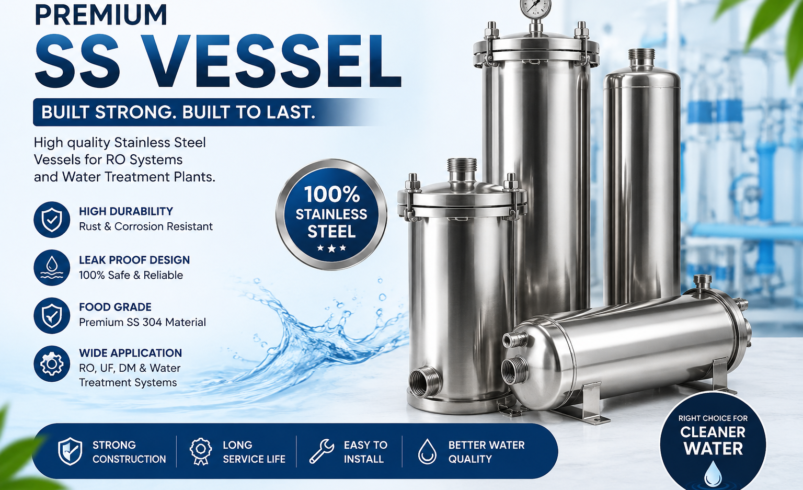

An SS Vessel may look like a simple tank from the outside, but its actual role can influence filtration performance, pressure handling, hygiene, maintenance, and the overall reliability of a water-treatment setup.
In the water-treatment industry, attention usually goes toward membranes, filters, pumps, and dosing equipment. However, the equipment that houses or supports the treatment media is equally important. This is where an SS Vessel becomes relevant.
Made primarily from stainless steel, these vessels are designed for applications where durability, structural strength, cleanliness, and resistance to corrosion are important. Depending on the system design, an SS vessel can be used with filtration media, softening media, activated carbon, or other treatment processes.
The interesting part is that the vessel itself does not necessarily perform the treatment. Instead, it provides the controlled environment in which the treatment process takes place.
What Is an SS Vessel?
An SS Vessel, or Stainless Steel Vessel, is a pressure-rated container used in various filtration and water-treatment applications.
The vessel can contain a selected treatment medium while allowing water to pass through it under controlled conditions.
A typical setup may include:
- Stainless-steel vessel body
- Top opening or control arrangement
- Inlet and outlet connections
- Internal distribution system
- Filtration or treatment media
- Valves and associated fittings
The exact construction depends on the application.
A domestic filtration unit may have very different requirements from a commercial or industrial water-treatment plant.
Why Stainless Steel?
The choice of stainless steel is not simply about appearance.
Water-treatment equipment often operates in environments where moisture is constantly present. Ordinary materials can be vulnerable to corrosion, surface degradation, or premature wear depending on the conditions.
Stainless steel offers a combination of:
- Corrosion resistance
- Mechanical strength
- Durability
- Easier cleaning
- Professional appearance
- Long-term service potential
However, the exact performance depends on the grade of stainless steel, fabrication quality, operating conditions, and maintenance.
So, saying that every stainless-steel vessel is suitable for every application would be incorrect.
The Vessel Is More Than Just a Container
One unique way to look at an SS vessel is to consider it as the working environment of the treatment media.
For example, if a filtration system uses activated carbon, the carbon needs an appropriate space through which water can pass.
If the system uses softening resin, that resin also requires a suitable vessel and internal distribution arrangement.
The vessel therefore provides the physical structure that allows the treatment media to perform its intended function.
Without the right vessel design, even high-quality media may not deliver the expected system performance.
How an SS Vessel Works in a Filtration System
The operating concept can be simple.
Water enters the vessel through the inlet.
It is distributed through the treatment media.
The media interacts with the water according to its intended treatment function.
The treated water then leaves through the outlet.
In some systems, the vessel may also support backwashing, rinsing, regeneration, or other maintenance cycles.
This means the vessel must be designed around the complete operating sequence rather than only normal filtration.
SS Vessel and Pressure
Pressure is one of the most important factors in vessel selection.
When water moves through a pressurized treatment system, the vessel must safely handle the intended operating conditions.
Important specifications may include:
- Working pressure
- Test pressure
- Operating temperature
- Vessel diameter
- Vessel height
- Connection size
- Material grade
- Wall construction
These specifications should be evaluated before selecting a vessel.
A vessel should never be selected solely on the basis of dimensions.
Why Vessel Size Changes the Treatment Process
Size affects more than capacity.
The dimensions of a vessel influence the amount of treatment media that can be installed and the way water interacts with that media.
A vessel that is too small may not provide sufficient media volume for the intended application.
A vessel that is unnecessarily large may increase equipment cost, footprint, and water requirements during certain operating cycles.
This is why vessel sizing should be connected to the actual flow rate and treatment objective.
The Importance of Flow Distribution
One of the less visible aspects of an SS vessel is its internal distribution system.
Water should not simply enter the vessel and pass through the easiest available path.
Ideally, the internal arrangement helps distribute flow through the treatment media in a controlled manner.
Poor distribution can lead to uneven media utilization.
That may result in some areas of the media working harder while other areas are not being used effectively.
Therefore, the internal distributor is an important part of the complete vessel assembly.
SS Vessel in Activated Carbon Filtration
Activated carbon is widely used in water-treatment applications for reducing certain unwanted substances, including taste- and odor-related compounds and some organic contaminants.
When carbon is used in a pressure vessel, the vessel provides the space needed for the carbon bed.
Water passes through the carbon according to the system’s design.
The effectiveness of the process depends on several factors, including:
- Carbon type
- Bed depth
- Flow rate
- Contact time
- Water characteristics
- Operating cycle
The SS vessel provides the structural platform, while the carbon performs the treatment function.
SS Vessel for Water Softening
Another application involves water-softening systems.
A softener can contain ion-exchange resin that interacts with water to reduce hardness under suitable operating conditions.
Here again, the vessel doesn’t perform the ion-exchange process itself.
It houses the resin and provides the necessary flow path.
Depending on the system, the vessel may need to accommodate service, backwash, brine-related regeneration, and rinse cycles.
That makes proper vessel design important for consistent operation.
Why Backwashing Changes the Requirements
Filtration isn’t always a one-direction, one-time process.
Many media-based systems require periodic backwashing.
During backwash, water moves through the vessel in the opposite direction to normal service flow.
The purpose can be to loosen accumulated particles and restore the media bed.
This creates additional hydraulic and mechanical requirements.
An SS vessel intended for such a system should therefore be compatible with the expected backwash conditions.
SS Vessel vs Other Vessel Materials
Stainless steel isn’t the only material used for water-treatment vessels.
Depending on the application, vessels may also be manufactured using composite materials, plastics, or other metals.
Each option has its own characteristics.
An SS vessel can be attractive where durability, structural strength, cleanability, and a metal construction are desired.
Composite vessels may offer advantages in weight and corrosion resistance.
The right choice depends on:
Application + pressure + water characteristics + installation environment + budget + maintenance requirements
There is no single vessel material that is perfect for every installation.
Why Surface Finish Can Matter
For some applications, the internal surface condition of the vessel can be important.
A smoother, properly finished surface can make cleaning easier and reduce locations where unwanted deposits may accumulate.
The importance of surface finish depends on the application.
Industrial process water, commercial filtration, and specialized hygienic environments may have different expectations.
This is another reason why the cheapest vessel is not necessarily the best vessel.
SS Vessel Selection Should Start With the Application
Before buying an SS vessel, it is useful to identify the actual purpose.
Ask:
What water is being treated?
What treatment media will be used?
What is the required flow rate?
What pressure will the system operate at?
Is backwashing required?
What connection arrangement is needed?
What stainless-steel grade is appropriate?
What installation space is available?
These questions create a much stronger foundation for selection.
What Happens When the Vessel Is Undersized?
An undersized vessel may create limitations in treatment capacity.
The available media volume may be insufficient.
Flow may become too high for the intended bed depth.
The treatment process may not achieve the expected contact conditions.
The system may also require more frequent maintenance.
The exact effect depends on the treatment process, but the general principle remains the same:
Vessel size should be selected according to system requirements, not guesswork.
What Happens When the Vessel Is Oversized?
Oversizing is not always harmful, but it can be inefficient.
A larger vessel can mean:
- Higher initial cost
- Larger installation footprint
- Greater media requirement
- Increased water requirement during certain cycles
- More difficult handling
For a commercial installation, space and operating efficiency can be important considerations.
The goal is usually not the biggest vessel.
The goal is the right vessel.
Why Maintenance Matters
Even stainless steel needs maintenance.
The treatment media inside the vessel has a service life.
Connections can require inspection.
Valves and internal components can wear.
External surfaces may accumulate deposits depending on the environment.
Regular inspection can help identify issues before they become larger problems.
A maintenance plan should be based on the application, water quality, operating hours, and manufacturer’s recommendations.
Signs That a Vessel System Needs Attention
A change in system performance doesn’t always mean the vessel body itself has failed.
Possible warning signs can include:
- Reduced flow
- Increased pressure drop
- Media breakthrough
- Leakage
- Unusual valve behavior
- Poor backwash performance
- Corrosion or surface damage
- Loose connections
Diagnosis should consider the entire filtration assembly.
The vessel, media, valves, distributors, and piping all work as a system.
Why SS Vessels Are Useful for Commercial RO Businesses
For RO dealers and water-treatment suppliers, SS vessels can represent an important category beyond domestic purifier components.
Commercial customers may require complete treatment solutions rather than individual filters.
A supplier dealing in:
- SS vessels
- Filter media
- Valves
- Pumps
- Dosing equipment
- Membranes
- Cartridge filters
- RO systems
can provide a broader range of water-treatment solutions.
This can help businesses serve customers with different capacities and treatment requirements.
SS Vessel as a Long-Term Infrastructure Component
A cartridge filter is generally replaced periodically.
Treatment media may also require replacement or regeneration.
A properly selected vessel, however, can remain part of the infrastructure for a much longer period.
That makes the initial selection more important.
Instead of thinking only about today’s purchase price, businesses should consider the expected operating environment over the vessel’s useful life.
A reliable vessel can become a stable foundation around which the treatment system is built.
The Role of Fabrication Quality
Two vessels can use stainless steel and still differ significantly in quality.
Fabrication details matter.
Important considerations can include:
- Welding quality
- Joint finishing
- Dimensional accuracy
- Port alignment
- Internal construction
- Surface finishing
- Pressure testing
- Quality-control procedures
For commercial and industrial installations, these details can have a direct impact on installation and long-term reliability.
Why SS Vessel Specifications Should Be Clearly Documented
A professional supplier should be able to provide relevant specifications.
These may include:
- Material grade
- Dimensions
- Operating pressure
- Connection details
- Capacity
- Design conditions
- Application suitability
Clear documentation makes product comparison easier.
It also helps technicians avoid selecting a vessel based only on appearance.
The Future of Water Treatment Is About Complete Systems
Water treatment is becoming increasingly integrated.
A modern system can combine:
SS Vessel for structural containment
Treatment Media for specific water-quality objectives
Valves for flow management
Pumps for pressure and circulation
Sensors for monitoring
Controllers for automation
Each component has a different role.
The best system is therefore not necessarily the one with the most advanced individual component.
It is the one where all components work together correctly.
Frequently Asked Questions
What is an SS Vessel?
An SS Vessel is a stainless-steel vessel used in filtration, softening, water treatment, and other fluid-processing applications.
What is an SS Vessel used for?
It can house treatment media such as activated carbon, softening resin, or other filtration media, depending on the system design.
Is an SS Vessel the same as an RO membrane housing?
No. An RO membrane housing is specifically designed to contain an RO membrane. An SS vessel is generally used as a larger treatment-media vessel or process vessel, depending on its design.
Why is stainless steel used?
Stainless steel can provide durability, structural strength, corrosion resistance, and a suitable surface for many water-treatment environments.
How do I choose an SS Vessel?
Consider the treatment application, flow rate, pressure, vessel dimensions, media requirement, connection type, temperature, and appropriate stainless-steel grade.
Does a bigger SS Vessel always perform better?
No. Vessel size should be matched to the treatment process and required capacity. Oversizing can increase cost and operating requirements without providing a practical advantage.
Conclusion
An SS Vessel is much more than a stainless-steel container.
It is the structural environment in which important water-treatment processes can take place. Whether it is supporting activated carbon filtration, water softening, media filtration, or another treatment process, the vessel must match the requirements of the complete system.
Its material, dimensions, pressure rating, internal distribution, connections, and fabrication quality can all influence how effectively the system operates.
For RO dealers, manufacturers, service professionals, and water-treatment suppliers, understanding these factors can make vessel selection more practical and reliable.
The key idea is simple: don’t select an SS Vessel only by size or price. Select it according to the water, media, flow, pressure, treatment process, and installation conditions it is expected to handle.
When the vessel is correctly matched to the application, it becomes a dependable foundation for the treatment system rather than simply another piece of equipment.