


Introduction
Enterprise AI is moving from experimentation into production, and that transition brings a new operational challenge: understanding what an AI system is actually doing after deployment. A model can be available, responsive, and technically healthy while still producing inaccurate answers, consuming excessive resources, or becoming slower as workloads increase.
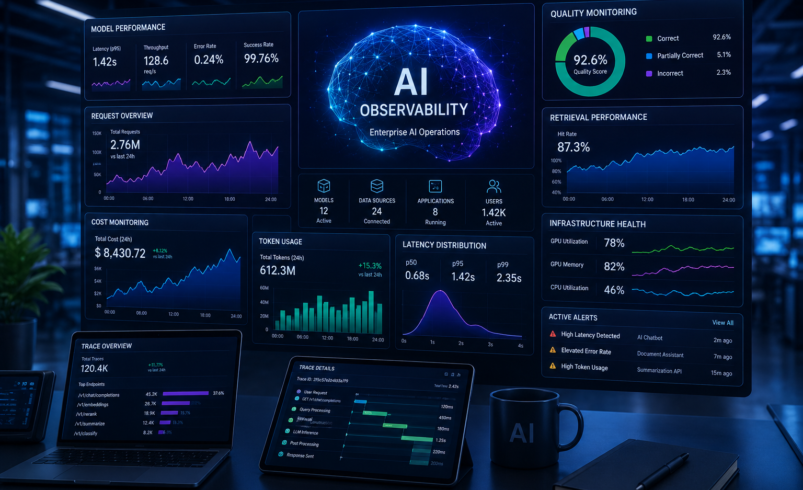
This is why AI Observability is becoming an important part of modern enterprise AI operations. It gives engineering and infrastructure teams visibility into model behavior, application performance, resource utilization, latency, token consumption, and response quality.
Traditional monitoring can tell a team whether a server is running or an API is responding. AI Observability goes further by helping teams understand the quality and behavior of AI workloads in production.
For organizations building scalable AI systems, Infratailors.ai provides an infrastructure-focused perspective on workload performance, resource efficiency, and the operational challenges involved in running AI applications at scale.
Why Enterprise AI Needs Observability
Traditional applications usually have predictable technical signals. An API request succeeds or fails, a server is available or unavailable, and a database query returns a result or produces an error.
Generative AI applications are different.
An LLM can return a successful response that is factually incorrect. A chatbot can remain online while its answers gradually become less useful. A RAG application can retrieve poor information and generate a convincing response from that information. Infrastructure can also remain healthy while token consumption and operating costs increase significantly.
These problems are difficult to identify using conventional application monitoring.
AI Observability provides a way to connect application behavior, model performance, infrastructure metrics, and quality signals so teams can understand what is happening inside production AI systems.
What AI Observability Tracks
Effective AI Observability covers multiple layers of an AI application.
At the model layer, teams can monitor response quality, model versions, latency, token usage, and generation behavior. At the application layer, teams can examine prompts, retrieval operations, tool calls, errors, and user interactions.
Infrastructure visibility adds another important dimension. GPU utilization, memory consumption, CPU usage, networking, storage, and workload distribution can reveal whether infrastructure is contributing to performance problems.
Connecting these signals makes troubleshooting much easier.
When an AI application becomes slow, for example, teams can investigate whether the problem is caused by a longer prompt, higher concurrency, GPU pressure, retrieval latency, or another infrastructure component.
AI Observability and LLM Performance
LLM performance depends on more than the model itself.
Model size, context length, prompt complexity, batching, GPU availability, memory capacity, and workload concurrency can all influence response time and throughput.
Without detailed telemetry, teams may attempt to solve performance problems by adding more infrastructure. That can increase costs without addressing the real bottleneck.
AI Observability provides evidence that helps teams understand performance behavior before making infrastructure changes.
For example, if GPU utilization remains consistently high while request latency increases, additional compute capacity may be necessary. If GPU utilization is low but latency remains high, the issue may exist somewhere else in the application pipeline.
This type of visibility allows organizations to make infrastructure decisions based on real workload behavior.
Monitoring AI Costs
Cost is another major reason enterprises need AI Observability.
LLM costs can increase because of higher request volume, longer prompts, larger context windows, inefficient retrieval, excessive model calls, or poorly optimized infrastructure.
A simple request counter does not reveal these patterns.
Teams need visibility into token consumption and infrastructure utilization to understand where money is being spent.
By analyzing token usage across applications, users, prompts, and models, organizations can identify inefficient workflows. Infrastructure metrics can then show whether GPU resources are being used effectively.
Infratailors.ai focuses on this connection between AI workloads and infrastructure efficiency, helping organizations understand how workload behavior can affect resource utilization and operating costs.
AI Observability for RAG Applications
Retrieval-Augmented Generation introduces additional complexity into AI applications.
A RAG system retrieves information from a knowledge source before providing that information to the LLM. If the retrieval system returns irrelevant, outdated, or incomplete content, the model may generate an inaccurate answer.
Without tracing the complete request, it can be difficult to determine where the failure occurred.
AI Observability allows teams to follow the request through retrieval, context construction, model inference, and final response generation.
This helps engineers distinguish between retrieval problems and model-generation problems.
For enterprise knowledge assistants, this visibility is especially valuable because the quality of the final answer depends heavily on the information supplied to the model.
Improving AI Reliability
Reliability in enterprise AI means more than keeping an application online.
A reliable AI application should provide consistent responses, predictable performance, controlled costs, and appropriate behavior under changing workloads.
Continuous AI Observability helps organizations establish performance baselines and identify changes over time.
If response quality declines after a prompt update, teams can investigate the change. If latency increases after a model version change, telemetry can reveal the relationship. If token consumption suddenly rises, usage data can help identify the responsible workflow.
This transforms AI operations from reactive troubleshooting into continuous performance management.
Connecting AI Observability With Infrastructure
One of the most important aspects of enterprise AI operations is connecting application-level telemetry with infrastructure-level metrics.
An AI application may depend on GPUs, inference servers, databases, vector stores, APIs, networking services, and other components.
Monitoring each component separately can create disconnected information.
A better approach is to connect the complete request path.
Infratailors.ai takes an infrastructure-focused approach to AI workloads, helping organizations understand how compute resources and infrastructure architecture affect AI application performance.
When AI Observability and infrastructure monitoring work together, engineering teams can identify bottlenecks faster and make better decisions about capacity, scaling, and optimization.
Building a Proactive AI Operations Strategy
Many organizations begin monitoring after an AI application experiences a production problem. By that point, historical information needed to identify the root cause may already be missing.
A proactive approach introduces AI Observability before the application reaches large-scale production.
Teams can establish baseline performance, monitor model behavior, measure token usage, evaluate response quality, and track infrastructure utilization from the beginning.
This makes future changes easier to evaluate.
When a new model, prompt, retrieval system, or infrastructure configuration is introduced, teams can compare its performance against previous baselines.
Choosing an AI Observability Strategy
The right observability strategy depends on the complexity of the AI environment.
A simple internal application may require basic prompt, response, latency, and cost tracking. A large enterprise AI platform may need distributed tracing, automated evaluation, model monitoring, infrastructure metrics, security logging, and detailed cost analysis.
Organizations should also consider scalability.
An observability system that works for a small proof of concept may not be suitable when an application processes millions of AI requests.
The goal should be to create an observability architecture that can grow alongside the organization’s AI workloads.
How Infratailors.ai Supports AI Operations
Production AI requires a strong connection between models, applications, and infrastructure.
Infratailors.ai helps organizations focus on the infrastructure requirements behind AI workloads, including performance, resource utilization, scalability, and optimization.
By understanding how workloads behave on available infrastructure, enterprises can make better decisions about GPU capacity, deployment architecture, scaling, and operational efficiency.
This infrastructure perspective complements AI Observability by connecting application performance with the underlying resources responsible for delivering that performance.
Conclusion
Enterprise AI requires more visibility than traditional application monitoring can provide. Models can produce incorrect responses, workloads can become unpredictable, and infrastructure costs can increase even when conventional monitoring shows that everything is operating normally.
AI Observability provides the deeper visibility required to understand model behavior, response quality, latency, token consumption, application workflows, and infrastructure performance.
When observability is combined with strong AI infrastructure practices, organizations can identify problems earlier, optimize resources, control costs, and build more reliable production AI applications.
Infratailors.ai helps enterprises approach AI operations from an infrastructure and workload optimization perspective, creating a stronger foundation for scalable and efficient AI deployment. As enterprise AI adoption continues to grow, AI Observability will become an increasingly important part of maintaining performance, reliability, and operational control.