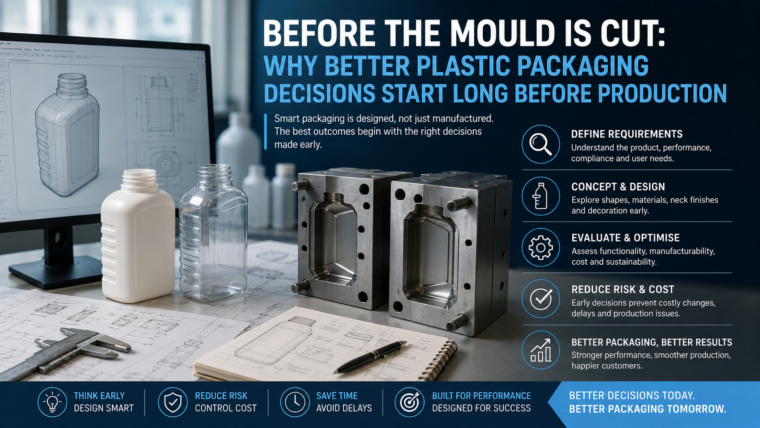

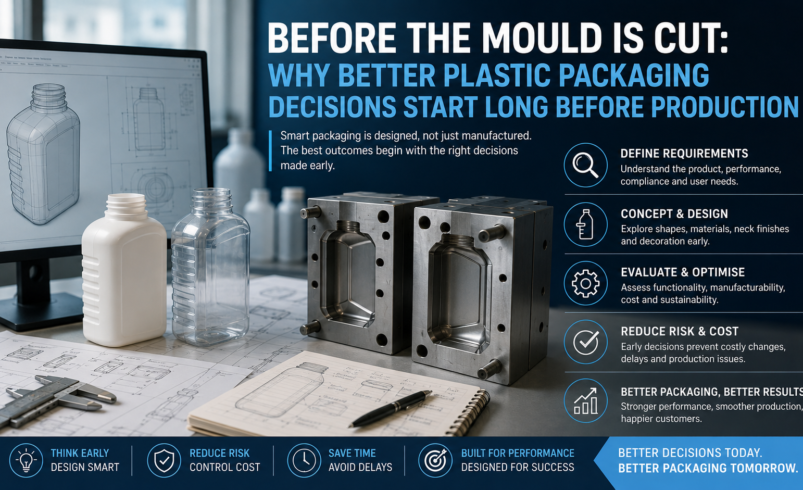

One of the most expensive moments to discover a packaging problem is after the production mould has already been made.
At that stage, what looked like a small design issue can become a tooling issue, a filling-line issue, a closure issue or a commercial delay.
That is why experienced packaging teams try to answer the difficult questions earlier.
They do not begin with, “How quickly can we manufacture this bottle?”
They begin with, “What exactly does this package need to do?”
A Packaging Concept Is Not Yet a Production Design
A marketing sketch can communicate brand direction.
A reference bottle can communicate preferred shape.
A 3D rendering can show what a finished product might look like.
None of those automatically prove that the component is ready for repeat manufacturing.
A production-ready package must eventually account for:
- plastic material
- wall distribution
- neck geometry
- closure compatibility
- mould construction
- manufacturing process
- decoration
- filling and handling
- commercial quantities
Start With the Product, Not the Bottle
The package exists to serve the product.
A pharmaceutical liquid, cosmetic cream, shampoo, lubricant and household chemical do not automatically require the same bottle even when the capacity is identical.
The development team should understand:
- what will be filled
- how much will be filled
- how the product will be dispensed
- how the customer will handle it
- how it will move through production and distribution
This early application information helps narrow the packaging route before expensive decisions are made.
Standard Packaging or Custom Development?
Custom packaging can create differentiation, but custom should not become the default answer to every requirement.
If an existing container already provides the necessary capacity, closure, usability and brand presentation, adopting or adapting an established format can simplify development.
A new mould makes more sense when the package needs a genuinely different:
- shape
- neck
- function
- dispensing arrangement
- brand identity
- component relationship
Think About the Closure at the Beginning
Bottles and caps are frequently discussed as separate purchases.
In use, they operate as one system.
A bottle design should therefore consider the proposed closure before tooling is finalized.
Questions include:
- What neck finish will be used?
- How will the closure engage?
- Is tamper evidence needed?
- Will the user reopen the package repeatedly?
- Is dispensing part of the closure function?
Ignoring those questions can create a beautiful bottle that is difficult to seal properly.
Design for the Filling Line, Not Only the Shelf
Packaging spends part of its life in front of consumers.
Before that, it must survive production.
The container may need to travel through:
- conveyors
- filling equipment
- capping stations
- printing or labeling
- inspection
- secondary packaging
A highly distinctive shape that becomes unstable on a production line may create more trouble than value.
Decoration Needs Space
Another common mistake is designing the entire component and only then deciding how to apply the brand.
Printing and marking have physical requirements.
Curved surfaces, moulded ribs, handles, textured areas and narrow panels can restrict where artwork can be placed.
If direct printing, pad printing, screen printing or engraving will be important, the decoration area should be considered during product development.
A Prototype Is Valuable Because It Makes the Design Physical
A screen makes everything look clean.
A physical model creates different questions.
How does it feel in the hand?
Does it appear too large?
Is the gripping area comfortable?
Is the logo area large enough?
Does the closure proportion look correct?
Early prototypes can help teams detect issues before production tooling turns them into expensive changes.
Mould Design Is a Commercial Decision Too
A mould is not simply a technical object.
It influences commercial production.
Tooling discussions may involve:
- component geometry
- cavity arrangement
- production requirements
- anticipated volume
- maintenance
- sample development
The right solution for an early-stage product with modest volume may differ from a packaging component intended for sustained high-volume production.
Production Volume Should Be Discussed Honestly
Brands sometimes approach manufacturers without a realistic quantity forecast.
That makes it harder to recommend the most appropriate development route.
A manufacturer does not necessarily need a perfect five-year forecast, but it helps to know whether the requirement is closer to:
- trial launch
- regional production
- national commercial scale
- large repeat orders
Cost Reduction Begins With Good Design
Buyers often try to reduce packaging cost only after receiving a quotation.
Yet some of the biggest cost decisions may already be built into the design.
Unnecessary weight, overly complex geometry, difficult decoration, unusual closures or inefficient tooling can all affect commercial production.
Good design considers manufacturability from the beginning.
Sampling Should Test More Than Appearance
A sample review should ask:
- Does the component match the approved dimensions?
- Does the closure work?
- Does it stand correctly?
- Is the branding area suitable?
- Does the package feel appropriate for the product?
- Does it integrate with the intended handling process?
Why Local Technical Communication Can Help
For Pakistani manufacturers and brand owners, working closely with a domestic packaging-development team can make iterative discussions easier.
Samples, drawings, reference components and revisions can be reviewed in the same commercial environment in which the finished packaging will eventually be used.
The real benefit is not simply geographical proximity.
It is shortening the distance between an idea and the technical people responsible for making that idea repeatable.
What Procurement Teams Should Ask Before Approving Tooling
Before giving final approval, confirm:
- What exact product will the package contain?
- Has the material route been reviewed?
- Is the bottle compatible with the intended closure?
- Has the manufacturing method been defined?
- Has decoration been considered?
- Have likely production volumes been discussed?
- Has a sample or prototype been reviewed where appropriate?
- Are critical functional dimensions agreed?
Choosing a Packaging Partner With Development Capability
When a project involves more than simply ordering an established stock container, buyers may benefit from working with a manufacturer that connects design, tooling and production rather than treating them as unrelated stages.
Companies researching this type of integrated approach can review what a rigid plastic packaging manufacturer in Pakistan should be able to discuss before a project moves into commercial tooling.
Final Thoughts
A mould should confirm a well-developed packaging decision—not compensate for a poorly defined one.
The earlier a business clarifies product requirements, closure behaviour, decoration, filling, volume and manufacturing expectations, the easier it becomes to create packaging that works beyond the first attractive sample.
Production starts at the machine.
Successful packaging development starts much earlier.