

Water is no longer just a basic utility for businesses—it has become an important part of daily operations. Whether it is a restaurant serving hundreds of customers, a school providing drinking water to students, a hotel managing guest requirements, or a factory using treated water in its operations, dependable water quality matters.
For businesses with moderate purified-water requirements, a 250 LPH RO Plant can offer a practical balance between purification capacity, operational convenience, and space requirements. The system is designed to produce up to 250 liters of purified water per hour under suitable operating conditions, making it relevant for a wide range of commercial applications.
But what makes a 250 LPH RO Plant different from simply installing several domestic water purifiers? And why are businesses increasingly considering commercial RO systems instead of relying on multiple small units?
The answer lies in capacity, centralized operation, easier monitoring, and the ability to design the treatment process according to the quality of the incoming water.
One Plant Instead of Multiple Small Purifiers
Imagine a restaurant where several water purifiers are installed at different locations. Each unit has its own filters, maintenance schedule, electrical connection, and potential service requirements.
As the business grows, managing multiple domestic systems can become inconvenient.
A commercial 250 LPH RO Plant approaches the requirement differently. Instead of dividing purification between several small machines, water treatment is centralized into a single system.
This can make monitoring and maintenance more organized. A centralized system can also be connected to suitable raw-water and purified-water storage tanks, allowing the business to manage water availability according to its operating schedule.
This is particularly useful for businesses where purified water is required at multiple points throughout the day.
Why 250 LPH Can Be a Practical Capacity
Not every business requires a large industrial RO plant.
A small commercial establishment may need significantly more water than a household but substantially less than a large manufacturing facility. This is where a 250 LPH capacity can become relevant.
At its nominal rating, a 250 LPH system can produce up to 250 liters of purified water in one hour under specified conditions. The actual output depends on feed-water quality, temperature, pressure, membrane condition, recovery, and system design.
For a business operating several hours a day, the plant can provide a substantial quantity of purified water without occupying the scale or infrastructure associated with a much larger industrial installation.
The important point is to calculate actual water consumption before selecting the capacity.
The Real Value Is in the Complete System
When people hear “250 LPH RO Plant,” they often focus only on the number 250.
However, the capacity is just one part of the system.
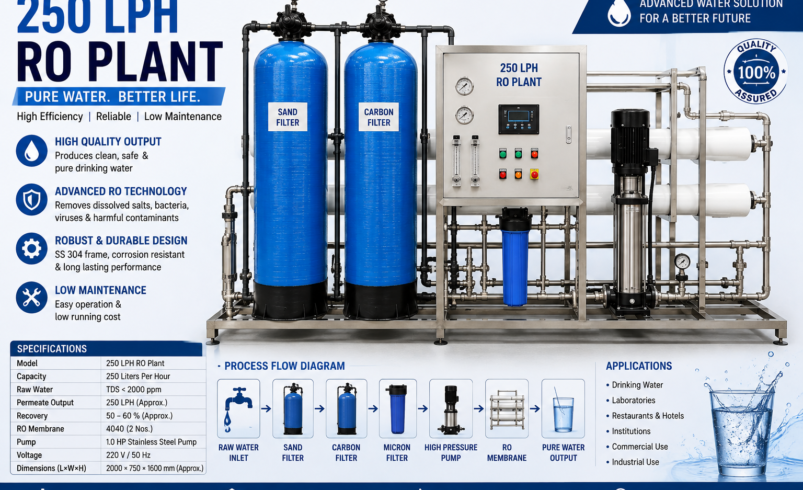
A commercial RO plant can include several stages and components working together. Depending on the water source, the system may incorporate raw-water storage, pre-filtration, activated carbon filtration, micron filtration, a high-pressure pump, RO membranes, controls, purified-water storage, and optional post-treatment.
Each component has a specific purpose.
The pre-treatment protects the RO membrane. The pump provides the pressure required for membrane operation. The membrane performs the primary dissolved-solids separation, while storage and control components help integrate the plant into the business’s daily water-use pattern.
This means two plants with the same 250 LPH rating may not be identical.
Their configurations can vary considerably depending on the application.
Feed Water Should Decide the Configuration
One of the biggest mistakes businesses can make is purchasing an RO plant first and thinking about water quality later.
The better approach is the opposite.
First understand the feed water.
Is it municipal water? Borewell water? Tanker water? A combination of sources?
Does it have high TDS? Hardness? Iron? Turbidity? Chlorine? Other specific contaminants?
The answers can influence the pre-treatment and membrane configuration.
For example, water with significant suspended particles may require effective filtration before reaching the membrane. Water containing chlorine may require suitable carbon treatment because certain RO membranes can be sensitive to chlorine exposure.
Similarly, high hardness or scaling potential can influence the treatment strategy.
This is why a water analysis is an important step before finalizing a commercial RO system.
Where a 250 LPH RO Plant Fits Into Daily Business
A 250 LPH RO Plant can be useful in situations where purified water is required repeatedly throughout the working day.
Restaurants and Food Businesses
Restaurants need water for drinking, food preparation, beverages, and other operations. Depending on the establishment, a centralized purification system can make water management more convenient.
Hotels and Guest Houses
Hotels have recurring water requirements from guests, kitchens, housekeeping, and other departments. A suitable RO system can support specific purified-water requirements based on the property’s size and operating pattern.
Schools and Colleges
Educational institutions can use commercial water treatment systems for drinking-water requirements where the consumption is higher than household levels.
Offices
Large offices may require purified drinking water for employees and visitors. Instead of depending on multiple domestic purifiers, a commercial system can be designed around the building’s consumption.
Clinics and Healthcare Facilities
Healthcare environments can have specific water-quality requirements. A commercial RO system may form one part of a broader water-treatment setup, depending on the intended use.
Small and Medium Manufacturing Units
Manufacturing businesses may require treated water for specific processes, employee consumption, or utility applications. The treatment configuration should be designed according to the process requirements.
When a 250 LPH Plant May Not Be Enough
Capacity planning is important.
A business with very high water consumption may quickly exceed the practical output of a 250 LPH system. In such cases, a higher-capacity plant or multiple treatment systems may be more appropriate.
For example, if a facility requires a large quantity of purified water continuously throughout the day, selecting a 250 LPH system simply because it is less expensive initially may create an operational bottleneck.
The right question is not:
“How much does a 250 LPH RO Plant cost?”
The better question is:
“How much purified water does my business actually need, and what system can deliver it reliably?”
Once that requirement is established, the appropriate plant capacity becomes much easier to determine.
Purification Capacity and Storage Work Together
A commercial RO plant does not necessarily have to produce water at the exact moment it is consumed.
Storage tanks can help businesses manage differences between production and consumption.
For example, a plant can operate during designated hours and fill a purified-water tank. The stored water can then be used during peak consumption periods.
This approach can be particularly useful when the business has predictable consumption patterns.
However, storage should be designed appropriately for the application. For drinking-water systems, tank material, hygiene, cleaning procedures, and sanitation are important considerations.
What Makes a Commercial RO Plant Different?
A domestic RO purifier is designed primarily around household requirements.
A commercial RO plant is built around a different operating model.
It generally involves larger-capacity filtration, pumps, membranes, controls, and storage arrangements. It can also be configured for specific feed-water conditions and operational requirements.
Commercial systems are therefore more suitable when a business needs:
- Higher purification capacity
- Centralized water treatment
- Regular daily operation
- Larger storage integration
- Application-specific filtration
- Easier centralized maintenance
This does not mean a commercial RO plant is automatically the right choice for every application. The equipment should always be matched to actual consumption and water quality.
The Importance of Membrane Selection
The RO membrane is at the heart of the purification process.
However, simply choosing a membrane based on capacity is not enough.
Membrane selection should consider feed-water chemistry, operating pressure, desired water quality, recovery, temperature, and system configuration.
A membrane operating outside its intended conditions can experience reduced performance or a shorter service life.
This is why reputable suppliers generally evaluate the water source and application before finalizing the membrane configuration.
Energy Efficiency Matters Too
A commercial RO plant consumes energy primarily through its pumping and associated electrical components.
Energy requirements can vary according to feed-water pressure, membrane configuration, pump selection, operating hours, and other system factors.
For a business running an RO plant every day, energy consumption becomes part of the long-term operating cost.
Selecting an appropriately sized pump and avoiding unnecessary overcapacity can help businesses operate the system more efficiently.
Don’t Ignore Reject Water
RO purification creates a reject stream containing a higher concentration of dissolved substances.
The quantity of reject water depends on the recovery rate and operating conditions.
Instead of viewing reject water only as waste, businesses should consider whether it can be safely reused for suitable non-potable purposes, depending on its quality and local requirements.
Possible applications may include cleaning, gardening, toilet flushing, or other suitable uses where regulations and water quality permit.
The reuse strategy should be evaluated carefully rather than assuming that reject water is suitable for every purpose.
Maintenance Is Part of the Investment
Buying a 250 LPH RO Plant is not the end of the process.
Like any commercial equipment, it needs regular attention.
Pre-filters may need replacement. Membranes may eventually require cleaning or replacement. Pumps and electrical components should be inspected. Storage tanks and pipelines may require cleaning and sanitation.
Monitoring product-water quality can also provide useful information about system performance.
A small issue identified early can often be easier to address than a major failure after prolonged operation.
Look Beyond the Initial Price
When comparing different 250 LPH RO Plants, the cheapest quotation is not necessarily the most economical option.
A better comparison should include:
Equipment quality + operating cost + maintenance + spare parts + service support + expected performance.
For example, a system with a lower purchase price but frequent membrane replacement may cost more over its operating life.
Similarly, a supplier offering installation and after-sales support can provide greater practical value than one offering equipment without adequate technical assistance.
Customization Can Make a Difference
Commercial water treatment is rarely a one-size-fits-all requirement.
A plant intended for municipal water may have a different configuration from one designed for borewell water.
Similarly, a restaurant may have different post-treatment requirements from a manufacturing unit.
This is why a 250 LPH RO Plant can often be configured according to the specific application.
The objective should be to create a treatment chain that addresses the actual characteristics of the feed water rather than adding unnecessary components.
A Better Way to Select Your RO Plant
Before placing an order, businesses can follow a simple decision process.
Start by identifying the water source.
Next, test the water.
Then calculate daily and peak purified-water consumption.
After that, determine whether 250 LPH provides sufficient capacity.
Once capacity is confirmed, evaluate pre-treatment, membrane selection, pump requirements, storage, automation, and post-treatment.
Finally, compare suppliers based on equipment specifications, warranty, service availability, spare parts, and long-term support.
This approach can help businesses avoid buying a system based purely on marketing claims or price.
Conclusion
A 250 LPH RO Plant can be a practical choice for businesses and institutions that need a dependable supply of purified water without moving immediately to a much larger industrial system.
Its biggest advantage is not simply its rated capacity. The real value comes from combining appropriate pre-treatment, reliable pumping, suitable RO membranes, proper storage, effective controls, and regular maintenance into one coordinated water-treatment solution.
From restaurants and hotels to schools, offices, healthcare facilities, and small manufacturing units, a properly designed 250 LPH RO Plant can fit a variety of water-purification requirements.
However, the best RO plant is not necessarily the one with the lowest price or the most features. It is the one that matches the water quality, consumption pattern, application, operating environment, and long-term maintenance needs of the business.
For organizations planning to install or upgrade a commercial water purification system, evaluating these factors before purchase can make the investment more practical, reliable, and sustainable in the long run.