

Hard water is one of the most widespread challenges facing residential, commercial, and industrial facilities today. Defined by high concentrations of dissolved minerals—primarily calcium ($text{Ca}^{2+}$) and magnesium ($text{Mg}^{2+}$)—hard water leaves heavy white scale on fixtures, corrodes water heaters, restricts piping networks, and severely reduces the efficiency of cleaning agents.
While control valves and brine tanks receive most of the attention in system design, the actual chemical transformation happens quietly within the vessel. At the center of this transformation lies water softener resin—an advanced engineered polymer media that strips hardness from water at the molecular level.
Evaluating the structural science of cation exchange media, analyzing crosslinking density differences, identifying environmental degradation factors, and selecting targeted formulations empowers property owners, system builders, and facility managers to optimize water quality and maximize equipment ROI.
The Molecular Architecture of Water Softener Resin
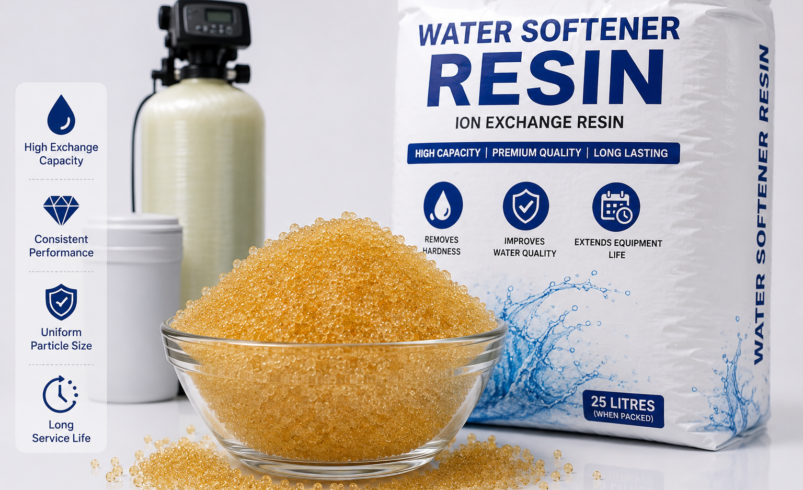
Water softener resin consists of millions of microscopic synthetic polymer spheres packed tightly within a pressurized mineral tank. These beads are manufactured by copolymerizing polystyrene with divinylbenzene (DVB). This chemical reaction produces a insoluble matrix featuring a high internal surface area filled with fixed functional exchange sites.
       [ Crosslinked Polystyrene Matrix ]
                     │
         - - - - - - - - - - - - -
        │ Negatively Charged Site │  <--- Holds Positively Charged Ions
         - - - - - - - - - - - - -
                     │
          Sodium Ions (Na+) held lightly
                     │
      Replaced by Calcium (Ca2+) / Magnesium (Mg2+)
During chemical processing, the polymer matrix is sulfonated to introduce negatively charged sulfonic acid functional groups ($-text{SO}_3^-$) throughout the bead structure. Because opposite electrical charges attract, these negatively charged sites hold onto positively charged single-valence ions like sodium ($text{Na}^+$) or potassium ($text{K}^+$).
The resulting beads typically measure between 0.3 and 1.2 millimeters in diameter, varying in appearance from translucent amber to deep brown based on manufacturing specifications and crosslinking density.
The Chemical Dynamics of Cation Exchange
Water softener resin works via a reversible process known as cation exchange. Cations are positively charged ions. Because calcium, magnesium, sodium, and potassium all carry positive charges, they compete for the negatively charged sulfonic binding sites distributed across the resin beads.
1. The Softening Phase (Service Cycle)
When untreated hard water enters the mineral tank, it percolates downward through the resin bed. Dissolved calcium ($text{Ca}^{2+}$) and magnesium ($text{Mg}^{2+}$) ions carry a double positive charge (divalent cations). Conversely, the pre-attached sodium ions ($text{Na}^+$) hold only a single positive charge (monovalent cation).
Because divalent ions exert a stronger electrostatic attraction toward the negatively charged sulfonic groups than monovalent ions, the resin acts as a chemical magnet:
The resin attracts and firmly binds the calcium and magnesium ions while releasing an equivalent charge of sodium ions into the water stream. The effluent water exiting the bottom distributor screen is stripped of scale-forming minerals, delivering soft water to downstream applications.
2. The Regeneration Phase (Restoring Capacity)
Over time, active exchange sites across the resin beads become saturated with calcium and magnesium. Once fully loaded, the media loses its softening capability and must undergo regeneration using a concentrated sodium chloride ($text{NaCl}$) brine solution.
[Service Phase]      Hard Water In (Ca2+/Mg2+)  ──►  Resin Binds Hardness  ──►  Soft Water Out (Na+)
[Regeneration]       Concentrated Brine In (Na+) ──►  Flushes Hardness     ──►  Waste to Drain
During regeneration:
-
Brine Injection: Concentrated salt brine is drawn from an adjacent salt tank and directed into the resin bed.
-
Mass Action Principle: The overwhelming concentration of sodium ions forces the resin matrix to release bound calcium and magnesium ions, swapping them back out for sodium.
-
Rinse & Flush: Displaced hardness minerals and excess salt brine are flushed safely down the drain, leaving the resin bed fully charged for the next operating cycle.
Analyzing Cation Exchange Resin Formulations
Selecting the right water softener resin requires evaluating water chemistry, raw source origin (city municipal vs. private groundwater), and chemical exposure risks.
+-----------------------------------------------------------------------------------+
|                            RESIN FORMULATION COMPARISON                           |
+--------------------------+-----------------------+--------------------------------+
| Feature / Attribute      | 8% Crosslink Resin     | 10% Crosslink Resin            |
+--------------------------+-----------------------+--------------------------------+
| DVB Content              | 8%                    | 10%                            |
| Structural Density       | Standard              | High / Compact                 |
| Chlorine Resistance      | Moderate              | Exceptional                    |
| Expected Lifespan (City) | 10–12 Years           | 15–20+ Years                   |
| Ideal Application        | Clean Well Water      | Chlorinated City Water         |
+--------------------------+-----------------------+--------------------------------+
1. Standard 8% Crosslink Resin
Standard residential units frequently deploy 8% crosslink resin, meaning 8% of the polymer structure consists of divinylbenzene (DVB). DVB serves as the cross-linking agent holding the polystyrene chains together.
-
Performance Profiles: Delivers high exchange capacity, rapid kinetics, and economical initial cost.
-
Operational Limits: Vulnerable to chemical oxidation from chlorine and chloramine disinfectants.
-
Optimal Environments: Private well water supplies devoid of chlorine, or systems fitted with dedicated carbon pre-filtration.
2. Premium 10% Crosslink Resin
Premium 10% crosslink resin features a higher DVB ratio, creating a tighter internal skeleton.
-
Performance Profiles: Exceptional resistance to chemical oxidation, reduced swelling/shrinking stress, and prolonged service life.
-
Operational Limits: Marginally higher initial capital expenditure than 8% resin.
-
Optimal Environments: Municipal water supplies treated with chlorine or chloramines, as well as high-temperature or aggressive water setups.
3. Fine Mesh Resin
Standard resin beads average 0.3 to 1.2 mm in diameter, whereas fine mesh resin uses smaller bead sizes (roughly 0.1 to 0.3 mm).
-
Key Advantage: By reducing bead diameter, total available surface area per cubic foot increases substantially. This allows fine mesh resin to trap dissolved clear-water iron (ferrous iron, $text{Fe}^{2+}$) up to 10 parts per million (PPM) without requiring separate iron removal filters.
-
Engineering Requirement: Fine mesh resin requires high-slotted bottom distributor screens inside the tank to prevent small beads from escaping into plumbing lines.
Environmental Factors Driving Media Degradation
Under favorable conditions, high-grade cation exchange resin maintains functional service life for 10 to 15 years. However, specific chemical and physical stressors accelerate media breakdown.
Common Degradation Pathways:
 ├── Chlorine Oxidation   ──► Causes bead swelling, physical softening, and gel formation
 ├── Iron/Manganese Fouling ──► Coats active bead surface, blocking exchange sites
 ├── Osmotic Shock         ──► Fractures beads into tiny fragments ("fines")
 └── Sediment Clogging     ──► Restricts flow channels, causing severe pressure drop
1. Chlorine and Chloramine Oxidation
Municipalities add chlorine or chloramines to disinfect water networks. These chemicals act as powerful oxidizers that break the DVB cross-links binding the polymer structure together. As cross-links rupture, resin beads absorb excess water, swell, turn mushy, and lose structural strength. Mushy resin loses exchange capacity and compresses under system water pressure, causing pressure drops.
2. Iron and Manganese Fouling
While fine mesh resin handles moderate amounts of dissolved iron, standard resin easily fouls when exposed to iron or manganese. When clear-water iron ($text{Fe}^{2+}$) oxidizes into insoluble ferric iron ($text{Fe}^{3+}$) during backwashing, it forms a rust coating over the bead surfaces, permanently blocking access to internal exchange sites.
3. Osmotic and Hydraulic Shock
During regeneration, resin beads shrink in high-salinity brine and expand when flushed with fresh water. Over thousands of cycles, this rapid expansion and contraction creates internal mechanical stress, causing lower-grade beads to crack and break into small fragments known as “fines.”
Identifying Media Exhaustion in Softening Systems
Recognizing when a resin bed requires service prevents downstream plumbing damage and keeps water quality consistent.
  [1] Hardness Leakage (Scale returns on fixtures and glassware)
  [2] Resin Beads in Aerators (Breakdown of bottom distributor or resin beads)
  [3] Discolored Softened Water (Yellowish/Tea-colored tint from decaying polymer)
  [4] Noticeable Water Pressure Drop (Mushed resin compressing inside the tank)
  [5] High Salt Consumption (System regenerates frequently without softening)
-
Persistent Mineral Scaling: When brine tanks contain adequate salt but scale continues to build up on fixtures, the resin bed has lost its functional exchange capacity.
-
Beads Present in Plumbing Fixtures: Finding small amber plastic spheres in sink aerators, showerheads, or toilet valves points to fractured beads or a failed bottom distributor screen inside the tank.
-
Yellow or Tea-Colored Effluent: As polystyrene matrices breakdown chemically, decaying polymer compounds leach into the water column, creating a yellow tint in fixtures.
-
Substantial Pressure Loss: When resin breaks down into a gel-like mush or fine fragments, it packs tightly at the base of the tank. This restricts flow pathways, causing pressure drops during water usage.
-
Increased Salt Consumption: When a control valve cycles through regenerations frequently without yielding soft water, the resin can no longer retain sodium ions during the brine cycle.
Step-by-Step Media Re-Bedding Procedure
Re-bedding a mineral tank with fresh resin is a cost-effective way to restore softening performance without replacing the entire physical system.
Materials & Setup Checklist
-
Replacement strong-acid cation exchange resin (typically 1.0 to 1.5 cubic feet for residential units)
-
Replacement center riser tube and distributor basket
-
Bucket or wet/dry shop vacuum
-
Garden hose
-
Large funnel
-
Protective tape (electrical or painter’s tape)
-
Food-grade silicone lubricant
Replacement Sequence:
[Bypass System] ──► [Remove Valve Head] ──► [Flush Old Resin] ──► [Insert New Riser/Basket] ──► [Pour New Resin] ──► [Reassemble & Sanitize]
Execution Protocol
-
System Isolation: Shift the bypass valve assembly into “Bypass” mode. Unplug the main control electronics and open a downstream cold water tap to depressurize the vessel.
-
Valve Removal: Disconnect plumbing fittings from the valve body. Carefully thread the control head counterclockwise off the top neck of the vessel.
-
Evacuating Spent Media: Lay the mineral tank on its side over a collection tarp. Insert a garden hose into the tank mouth to flush out the wet media slurry. A commercial wet/dry vacuum can also be used to remove old media.
-
Riser Assembly Placement: Thoroughly rinse the interior tank walls. Center a new riser tube equipped with a bottom distributor basket inside the tank until it sits flush against the bottom dish.
-
Covering the Riser: Place a strip of protective tape over the top opening of the center riser tube. This prevents resin beads from entering the distributor line during filling. Any resin entering the riser tube will bypass filtration and discharge directly into household plumbing.
-
Loading New Media: Position a funnel over the tank mouth and pour in the fresh cation exchange resin. Fill the vessel to approximately 60% to 65% of its total depth. Leave the top third empty to allow necessary expansion space during backwash cycles.
-
Reassembly and Startup: Remove the protective tape from the riser tube. Clean any residual media off the neck threads, apply silicone lubricant to the valve O-rings, and thread the valve head back onto the tank. Slowly return the bypass valve to the “Service” position, allowing the tank to fill with water before running a manual backwash cycle to clear air pockets and dust.
Best Practices for Long-Term Resin Maintenance
Implementing proactive care routines preserves ion-exchange kinetics and extends resin longevity.
+-----------------------------------------------------------------------------------+
|                         RESIN PREVENTIVE MAINTENANCE CHECKLIST                    |
+--------------------------+-----------------------+--------------------------------+
| Maintenance Task         | Frequency             | Purpose                        |
+--------------------------+-----------------------+--------------------------------+
| Carbon Pre-Filtration    | Continuous / Annual   | Removes chlorine oxidation     |
| Sediment Pre-Filter      | Every 3–6 Months      | Prevents dirt/silt clogging    |
| Chemical Resin Cleaner   | Every 1–3 Months      | Strips bound iron & manganese  |
| High-Purity Salt Usage   | Ongoing               | Prevents insoluble dirt buildup|
+--------------------------+-----------------------+--------------------------------+
-
Upstream Carbon Filtration: Installing an activated carbon filter upstream of the softening tank removes chlorine and chloramines, protecting the DVB cross-links from oxidation and extending standard 8% resin life.
-
Sediment Protection: A 5-micron pre-filter captures rust scale, sand, and turbidity before it can settle within the resin bed matrix.
-
Targeted Chemical Washing: For applications with trace iron or manganese, dosing the brine well with liquid resin cleaners (formulated with phosphoric or citric acids) chemically strips metal deposits off exchange sites.
-
High-Purity Salt Utilization: Use high-purity solar or evaporated salt pellets (99.6% pure) to prevent dirt and insoluble binders from contaminating the resin bed.
Frequently Asked Questions
Q1: Can fresh resin be added directly on top of spent resin?
No. Never mix fresh resin with degraded media. Old resin packs tightly, harbors foulants, and contains broken fragments that restrict flow channels and degrade new media efficiency. Always empty and flush the tank completely before adding new resin.
Q2: Does the ion exchange process significantly increase sodium levels in drinking water?
The sodium added during softening directly corresponds to raw water hardness levels. Softening water with 10 grains per gallon (GPG) of hardness adds roughly 37 milligrams of sodium per 8-ounce glass—a negligible amount compared to average dietary intake. However, individuals on strict low-sodium diets can install a drinking water reverse osmosis unit to remove added sodium.
Q3: Can potassium chloride be substituted for sodium chloride during regeneration?
Yes. Potassium chloride ($text{KCl}$) serves as a sodium-free regenerant alternative. While effective, potassium chloride is generally more expensive and requires roughly 10% to 15% more material by weight per cycle to achieve equivalent hardness removal capacity.
Q4: How is resin volume calculated for standard vessel dimensions?
Resin volume is measured in cubic feet and matches tank dimensions:
-
9″ x 48″ Vessel: Requires 1.0 cu. ft. (30,000 grain rating)
-
10″ x 54″ Vessel: Requires 1.5 cu. ft. (45,000 grain rating)
-
12″ x 52″ Vessel: Requires 2.0 cu. ft. (60,000 grain rating)
Final Thoughts
Water softener resin serves as the essential component behind ion-exchange water treatment. By choosing the right crosslinking density, mitigating chemical oxidation risks through pre-filtration, and addressing media exhaustion proactively, operators can maintain peak softening performance and protect equipment investments for years to come.