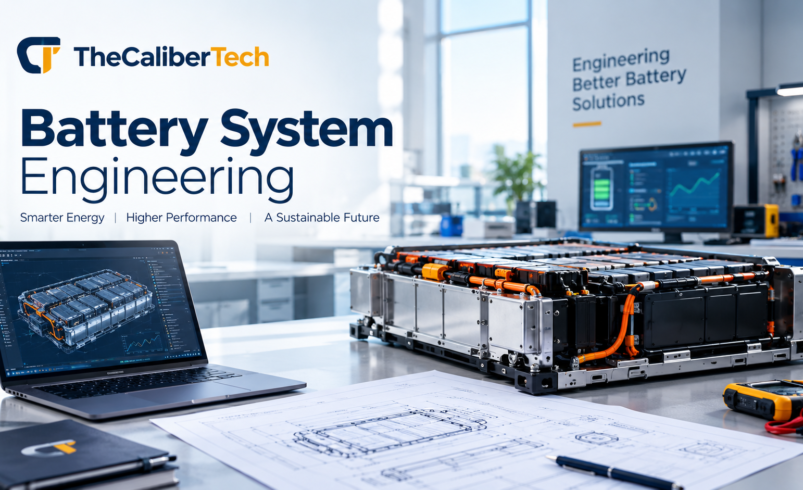

Battery System Engineering is essential for developing battery-powered products that deliver dependable performance, safe operation, and practical service life. It involves planning and integrating battery cells, electrical circuits, monitoring electronics, cooling systems, and protective structures into a complete solution. These systems support applications ranging from electric vehicles and portable equipment to renewable energy storage and industrial power supplies.
The engineering process begins with understanding how a battery will be used. Engineers must determine the required energy capacity, power output, charging time, operating temperature, and expected lifetime. They then design a system that meets these requirements while controlling cost, weight, and safety risks. Effective Battery System Engineering considers the complete product, not just the battery cells, because electrical, mechanical, and thermal decisions influence how the entire system performs.
1. Establishing Battery System Requirements
A reliable battery design starts with clear specifications. Without accurate requirements, engineers may select cells that provide insufficient power, create unnecessary weight, or fail to meet expected operating conditions.
Defining Energy and Power Needs
Energy capacity describes how much energy a battery can store, commonly expressed in kilowatt-hours (kWh). Power output, measured in kilowatts (kW), describes how quickly the battery can supply that energy.
For example, a commercial building using battery storage may need several hours of backup electricity. An electric forklift may require a different balance, with enough energy for a work shift and sufficient power for lifting and movement.
Engineers examine normal operating loads, peak demand, daily usage patterns, charging opportunities, and reserve requirements. They also account for energy conversion losses and the usable capacity permitted by the battery manufacturer.
Evaluating the Operating Environment
The environment affects battery selection and system architecture. Outdoor installations may experience wide temperature changes, moisture, dust, and direct sunlight. Vehicle batteries must also tolerate vibration, mechanical shock, and restricted installation space.
Engineers use these conditions to establish enclosure requirements, cooling methods, insulation arrangements, and maintenance access. Defining the environment early helps avoid expensive modifications after prototypes have been manufactured.
2. Battery Cell Selection and Pack Configuration
Comparing Battery Chemistries
Battery chemistry influences energy density, charging performance, operating temperature, cycle life, and cost. Lithium-ion batteries are common in modern applications, but their different chemistries offer different advantages.
Lithium iron phosphate (LFP) is often selected for stationary energy storage because of its cycle-life characteristics and comparatively strong thermal stability. Nickel manganese cobalt (NMC) cells are often considered when high energy density is important, such as in applications with strict space and weight limits.
The correct choice depends on the required performance, operating conditions, budget, and safety strategy. Engineers must review manufacturer specifications and verify that the selected cells are suitable for the intended application.
Designing Series and Parallel Connections
Cells are connected in series to increase pack voltage and in parallel to increase capacity and current capability. The combination determines the battery’s electrical characteristics.
During pack design, engineers calculate the number of cells needed to achieve the required voltage and energy capacity. They also evaluate conductor size, electrical resistance, connection quality, insulation, and protection against short circuits.
Cell consistency is another important factor. Differences in capacity or internal resistance can cause cells to behave differently during charging and discharging. Appropriate cell selection, monitoring, and balancing help manage these variations.
3. Electrical Integration and Battery Management
Designing the Electrical Architecture
A battery system includes more than cells and connecting wires. Depending on the application, it may contain fuses, contactors, current sensors, pre-charge circuits, connectors, isolation monitoring, and power conversion equipment.
These components must be selected according to system voltage, expected current, fault conditions, and environmental requirements. For example, a high-voltage vehicle battery needs carefully designed isolation and switching arrangements to manage electrical hazards during operation and maintenance.
Engineers also assess resistance in busbars and connectors. Excessive resistance can waste energy and generate heat, particularly when high current flows through the system.
Understanding the Battery Management System
The battery management system (BMS) monitors battery conditions and helps keep operation within specified limits. It commonly measures cell voltages, pack current, and temperatures.
A BMS may estimate state of charge (SOC), which indicates the remaining charge, and state of health (SOH), which reflects the battery’s condition compared with its original capability. These estimates help the system control power delivery and provide useful information for maintenance.
Other functions may include cell balancing, fault detection, data logging, communication with external controllers, and control of contactors. The exact capabilities depend on the system design.
4. Thermal Management and Physical Protection
Maintaining Suitable Temperatures
Battery cells produce heat during charging and discharging. High current, rapid charging, and elevated ambient temperatures can increase this heat generation.
If cells operate outside their permitted temperature range, performance may decline and degradation may accelerate. Certain lithium-ion cells can also be damaged if charged at temperatures below their specified limits.
Thermal management may use passive cooling, forced air, liquid cooling, or heating elements. Engineers assess heat generation, airflow, coolant distribution, sensor placement, and temperature differences across the pack.
A well-designed system aims to keep cells within the manufacturer’s operating limits under expected conditions, including demanding workloads.
Mechanical Design and Enclosure Safety
The battery enclosure protects cells and electrical components from impact, vibration, dust, moisture, and other environmental hazards. Its design must provide suitable structural strength without adding unnecessary weight or volume.
Engineers consider mounting points, material selection, sealing, connector placement, and access for inspection. Mechanical simulation can help evaluate structural loads and identify areas that may need reinforcement.
The enclosure and surrounding equipment must also be compatible with the battery’s thermal and electrical protection strategy. Mechanical protection alone cannot prevent every battery hazard, so it must work alongside monitoring and electrical safeguards.
5. Simulation, Testing, and Quality Assurance
Using Engineering Simulation
Simulation allows engineers to examine battery behavior before building a physical prototype. Electrical models can estimate voltage response and power losses. Thermal models help identify hot spots, while mechanical analysis can evaluate vibration response and enclosure strength.
These tools can reduce unnecessary design changes and help compare different configurations. However, simulations rely on model assumptions and accurate input data. They must be supported by testing.
Validating the Finished System
Testing checks whether the integrated battery meets its performance and safety requirements. Depending on the application, validation may include:
- Charge and discharge capacity measurements.
- Power output and energy efficiency checks.
- Temperature monitoring under different loads.
- BMS functionality and fault-response testing.
- Electrical insulation and protective-device checks.
- Vibration, shock, and environmental testing where applicable.
Manufacturers should use suitable test procedures and applicable industry standards. Recording results also supports quality control, troubleshooting, and future product improvements.
6. Practical Benefits of Battery System Engineering
A systematic engineering process can deliver several practical advantages.
Better energy efficiency: Appropriate conductor sizing and low-resistance connections help reduce electrical losses.
Improved service life: Suitable temperature control and charging limits can help reduce avoidable battery degradation.
Increased safety: Coordinated electrical protection, monitoring, and mechanical safeguards help manage foreseeable hazards.
Greater reliability: Component qualification and system-level validation can reveal weaknesses before deployment.
Application-specific performance: Engineers can match capacity, power, cooling, and enclosure design to the intended workload.
More effective maintenance: Monitoring data can help identify abnormal behavior and support decisions about inspection or replacement.
These outcomes depend on the quality of the design, manufacturing process, installation, and ongoing operation. Good engineering reduces risks but cannot eliminate every possible failure.
7. Common Challenges and Considerations
Battery designers frequently face competing requirements. Increasing capacity can add weight and cost, while more advanced cooling may improve temperature control but increase system complexity.
Battery degradation must also be considered. Capacity generally declines over time, and internal resistance may rise. The rate depends on factors such as temperature, charging current, depth of discharge, and usage patterns. Engineers should account for expected degradation when defining usable capacity and lifetime targets.
Manufacturing consistency presents another challenge. Variations between cells can affect pack performance, making supplier qualification and quality inspection important. Businesses must also consider applicable regulations, transport requirements, recycling, and end-of-life handling.
A clear specification, realistic performance targets, and cooperation between electrical, mechanical, thermal, and manufacturing teams help balance these demands.
Frequently Asked Questions
1. What is Battery System Engineering used for?
It is used to design and validate complete battery solutions for electric vehicles, energy storage installations, industrial machinery, backup power, and other battery-powered equipment.
2. How do engineers determine the required battery capacity?
They evaluate energy consumption, operating duration, peak loads, charging opportunities, conversion losses, and the amount of energy that must remain available during operation.
3. Why is the battery management system important?
The BMS monitors battery conditions, estimates charge and health, supports cell balancing, and helps initiate protective actions when operating limits are exceeded.
4. Can battery simulation replace physical testing?
No. Simulation helps predict performance and compare designs, but physical testing is necessary to confirm model results and evaluate the complete system under representative conditions.
5. What factors influence battery service life?
Service life depends on cell chemistry, temperature, charging and discharging patterns, depth of discharge, current levels, manufacturing quality, and the effectiveness of system controls.
Conclusion
Battery System Engineering combines electrical architecture, cell selection, thermal management, mechanical protection, monitoring, and testing to create dependable energy storage solutions. Every design decision affects how efficiently and safely a battery operates throughout its working life.
By defining requirements accurately, selecting suitable components, validating the complete system, and planning for maintenance, engineers can develop battery solutions that meet practical application needs. This structured approach helps manufacturers improve reliability, manage costs, and support the growing demand for electric mobility and energy storage.