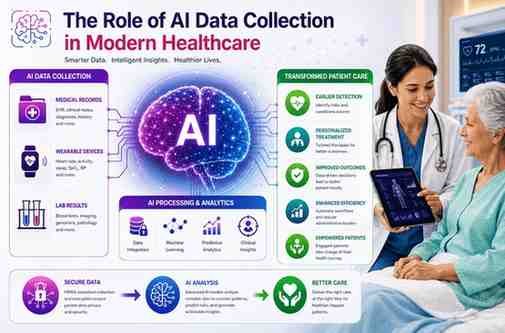


Healthcare organizations across the United States are generating more patient data than ever before. From electronic health records (EHRs) and wearable devices to medical imaging and remote patient monitoring, the volume of healthcare data continues to grow rapidly. However, collecting, organizing, and analyzing this information manually is both time-consuming and prone to errors.
This is where AI Data Collection for Healthcare is transforming the industry. Artificial intelligence enables healthcare providers to gather accurate, real-time data from multiple sources while improving operational efficiency and patient outcomes. At the same time, healthcare organizations must address challenges such as data privacy, security, and regulatory compliance.
In this article, we’ll explore the key benefits, potential risks, and best practices of implementing AI-powered data collection in healthcare.
What Is AI Data Collection for Healthcare?
AI Data Collection for Healthcare refers to the use of artificial intelligence technologies to automatically collect, organize, validate, and analyze medical data from various healthcare systems. Instead of relying solely on manual data entry, AI can extract information from electronic health records, medical devices, laboratory reports, imaging systems, insurance claims, and patient-generated health data.
Machine learning algorithms can also identify inconsistencies, eliminate duplicate records, and prepare structured datasets for clinical decision-making, research, and predictive analytics.
The result is cleaner, faster, and more reliable healthcare data.
Key Benefits of AI Data Collection for Healthcare
Improved Data Accuracy
Manual data entry often leads to human errors, duplicate records, and incomplete patient information. AI systems automatically validate and standardize incoming data, significantly reducing mistakes.
Accurate patient records allow physicians to make better clinical decisions while minimizing treatment delays caused by incorrect or missing information.
Faster Clinical Decision-Making
Healthcare professionals need access to accurate information in real time. AI-powered data collection gathers patient information from multiple systems instantly, providing clinicians with a comprehensive view of each patient’s medical history.
This enables faster diagnoses, timely interventions, and improved patient care.
Better Patient Outcomes
When healthcare providers have complete and accurate patient data, they can identify health risks earlier and recommend personalized treatment plans.
AI also supports predictive analytics by recognizing patterns that may indicate disease progression, hospital readmissions, or adverse drug reactions before they become critical.
Increased Operational Efficiency
Hospitals and clinics spend thousands of hours managing administrative tasks. AI automates data collection, reducing paperwork and allowing healthcare staff to focus more on patient care.
Automated workflows also improve scheduling, billing accuracy, insurance processing, and resource allocation.
Enhanced Medical Research
Healthcare researchers depend on large, high-quality datasets to develop new treatments and improve patient care. AI simplifies data collection from multiple healthcare institutions while maintaining consistency and reducing manual effort.
Researchers can analyze larger datasets more efficiently, accelerating medical discoveries and clinical trials.
Risks of AI Data Collection for Healthcare
While the advantages are significant, organizations should also understand the potential risks before implementing AI solutions.
Data Privacy Concerns
Healthcare data contains highly sensitive personal information. Improper handling or unauthorized access can lead to privacy violations and loss of patient trust.
Organizations must ensure that AI systems comply with HIPAA regulations and implement strict access controls and encryption.
Cybersecurity Threats
As healthcare organizations become more digital, cyberattacks continue to rise. AI systems connected to multiple databases may become attractive targets for hackers if security measures are inadequate.
Regular security assessments, endpoint protection, and continuous monitoring are essential to safeguard patient information.
Algorithm Bias
AI systems learn from historical data. If training datasets contain biases or incomplete demographic representation, AI may produce inaccurate recommendations for certain patient populations.
Healthcare providers should regularly evaluate AI models for fairness, transparency, and clinical accuracy.
Regulatory Compliance Challenges
Healthcare organizations must comply with evolving federal and state regulations regarding patient data management. AI implementation requires careful governance to ensure compliance with HIPAA, HITECH, and other applicable healthcare standards.
Organizations should establish clear data governance policies before deploying AI solutions.
Best Practices for Implementing AI Data Collection in Healthcare
Successful adoption of AI Data Collection for Healthcare requires more than selecting the right software. Healthcare organizations should develop a comprehensive implementation strategy that includes:
- Prioritize HIPAA-compliant AI platforms
- Use encrypted data storage and secure data transmission
- Regularly audit AI models for accuracy and bias
- Integrate AI seamlessly with existing EHR systems
- Train healthcare staff on AI-assisted workflows
- Establish strong data governance and access controls
- Continuously monitor system performance and compliance
Following these best practices helps organizations maximize AI’s benefits while minimizing operational and security risks.
The Future of AI Data Collection for Healthcare
Artificial intelligence will continue reshaping healthcare over the coming years. Emerging technologies such as generative AI, predictive analytics, and intelligent automation will further improve how healthcare organizations collect and use patient information.
Future AI systems will support personalized medicine, remote patient monitoring, clinical decision support, and population health management with even greater accuracy.
As interoperability between healthcare systems improves, AI-powered data collection will enable providers to deliver more connected, efficient, and patient-centered care.
Conclusion
AI Data Collection for Healthcare is becoming a cornerstone of modern healthcare operations. By automating data collection, improving accuracy, and enabling faster clinical decisions, AI helps healthcare providers enhance patient outcomes while reducing administrative burdens.
However, successful implementation also requires careful attention to privacy, cybersecurity, regulatory compliance, and ethical AI practices.
Healthcare organizations that invest in secure, intelligent AI data collection solutions today will be better positioned to deliver high-quality care, improve operational efficiency, and stay competitive in the rapidly evolving healthcare landscape.
If your organization is exploring AI-powered healthcare solutions, partnering with an experienced technology provider can help you implement scalable, compliant, and future-ready AI systems that drive measurable results.