
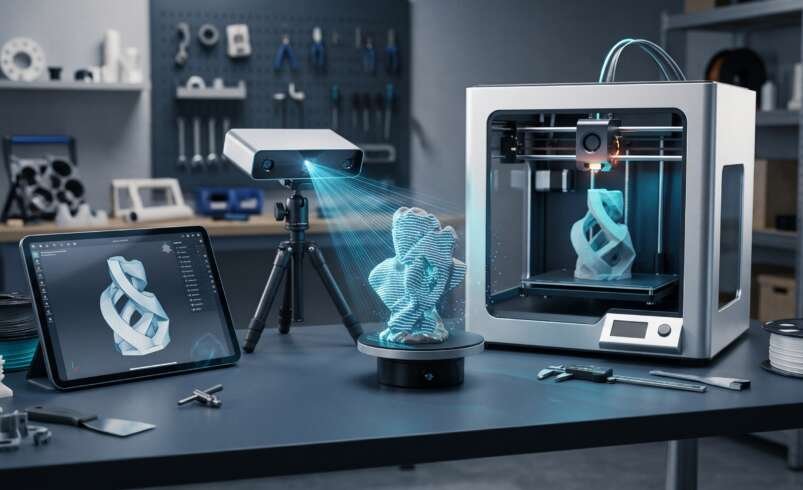

Choosing the best 3D scanner for 3D printing depends on the size, shape, surface, and level of detail of the objects you want to reproduce. A suitable scanner can capture real-world objects and convert their geometry into digital 3D models that can be edited, repaired, and prepared for printing.
Whether you are a hobbyist, product designer, engineer, or professional maker, the right scanner can simplify the process of recreating existing objects, repairing broken components, developing custom products, and producing detailed miniatures.
However, not every scanner delivers the same results. Some are designed for small, intricate objects, while others are better suited to larger components and complex surfaces. Understanding these differences will help you select equipment that fits your 3D printing workflow.
What Makes a Good 3D Scanner for 3D Printing?
A good 3D scanner should capture enough geometric detail to create a usable digital model. Several specifications influence the quality of the final printed object.
Scanning accuracy: Accuracy determines how closely the captured measurements represent the physical object’s actual dimensions. It is particularly important when reproducing mechanical parts, replacement components, and objects that must fit together.
Resolution: Resolution describes the spacing between captured surface points. Higher resolution can help preserve small features, edges, and surface details.
Scanning range: Consider the dimensions of your typical objects. A scanner designed for jewelry and miniatures may not be practical for furniture, automotive components, or larger models.
Surface compatibility: Black, transparent, reflective, and glossy objects can challenge optical scanners. Some scanning technologies handle these surfaces better than others, while certain objects may require scanning spray.
Software compatibility: Your scanner should support practical export formats such as STL, OBJ, or 3MF so that scanned models can be transferred into compatible modeling and slicing applications.
Best 3D Scanners for 3D Printing
Based on published manufacturer specifications and different scanning applications, these are several Revopoint options worth considering.
1. Revopoint POP 4: Best Overall for Versatile 3D Printing
The Revopoint POP 4 is a versatile option for makers who need to scan different types of objects rather than working with one specific category.
It combines blue multi-line laser, near-infrared full-field structured light, and VCSEL structured-light technologies. Its five scanning modes allow users to select an appropriate approach for different surfaces and object geometries.
According to Revopoint’s published specifications, its blue laser mode offers single-frame accuracy up to 0.03 mm, while full-field structured-light mode offers up to 0.08 mm. Its laser-mode volumetric accuracy is specified as 0.03 mm + 0.05 mm × L (m).
These capabilities make the POP 4 worth considering for:
- Custom product reproduction.
- Medium-sized mechanical components.
- Replacement parts and accessories.
- Complex surface capture.
- General scan-to-print projects.
Its blue laser mode can capture many dark and reflective surfaces without scanning spray. However, transparent objects may still require surface preparation.
For users who want flexibility across different scanning projects, the POP 4 is a strong all-around candidate.
2. Revopoint MINI 2: Best for Small and Detailed Objects
The Revopoint MINI 2 is designed for capturing intricate details on small objects.
It uses dual-camera blue structured-light technology and offers single-frame precision up to 0.02 mm and single-frame accuracy up to 0.05 mm.
Its minimum recommended scanning volume is 10 × 10 × 10 mm, making it suitable for small components that require detailed surface capture.
Potential applications include:
- Miniature models and figurines.
- Jewelry components.
- Small mechanical parts.
- Detailed product prototypes.
- Customized decorative objects.
The MINI 2 also supports STL, OBJ, PLY, and 3MF exports, among other formats.
One limitation is its relatively short working distance of 120–250 mm. It is therefore better suited to small-object scanning than large household or automotive projects. Transparent, dark, and highly reflective objects may also require scanning spray.
3. Revopoint INSPIRE 2: Best for Hobbyists and Makers
The Revopoint INSPIRE 2 is an option for hobbyists and makers looking for a portable scanner for everyday 3D printing projects.
It combines infrared structured light with infrared multi-line laser scanning. According to the manufacturer, it offers single-frame accuracy up to 0.05 mm and precision up to 0.03 mm.
Its supported scanning volume ranges from 20 × 20 × 20 mm to 2 × 2 × 2 m, providing flexibility for small-to-medium objects and larger scanning projects.
It can be useful for:
- Household object reproduction.
- Custom accessories.
- Medium-sized decorative models.
- Product prototyping.
- General hobbyist scanning.
The INSPIRE 2 also supports STL, OBJ, PLY, and 3MF exports. Its relatively accessible product category makes it worth evaluating for users who do not require a specialized industrial scanning system.
4. 3DMakerPro Seal Lite: An Alternative for Small Objects
The 3DMakerPro Seal Lite is another scanner worth comparing, particularly for users interested in small-format scanning.
Its published specifications include 0.02 mm accuracy, 0.07 mm resolution, and a typical scanning object size of 10–300 mm.
It uses blue structured-light technology and supports STL, OBJ, PLY, and ASC exports through JMStudio.
However, it offers monochrome texture rather than full-color texture capture. Certain transparent and reflective surfaces may also require scanning spray.
When comparing the Seal Lite with Revopoint’s MINI 2, consider working distance, scanning workflow, software compatibility, surface requirements, and actual project needs. Manufacturer accuracy figures should not be treated as directly interchangeable because testing conditions can differ.
How to Choose the Right 3D Scanner for Your Printer
Before purchasing a scanner, identify what you intend to print.
| Your 3D printing project | Scanner worth considering |
|---|---|
| Mixed-size objects and different surfaces | Revopoint POP 4 |
| Miniatures and intricate components | Revopoint MINI 2 |
| Hobbyist and general maker projects | Revopoint INSPIRE 2 |
| Small-object scanning alternative | 3DMakerPro Seal Lite |
Also consider your computer’s processing capabilities, included accessories, software licensing, and total purchase cost.
A scanner with advanced specifications may not be the best investment if your projects only require basic shape reproduction.
How to Turn a 3D Scan into a Printable Model
Capturing an object is only the beginning. A successful scan-to-print workflow involves several steps.
Step 1: Scan the original object. Capture the object from multiple angles to collect sufficient surface information. Use markers or an appropriate tracking method when necessary.
Step 2: Process the scan. Remove unwanted points, align individual scans, and merge the captured geometry into a consistent model.
Step 3: Repair the mesh. Check for holes, disconnected surfaces, overlapping geometry, and other mesh problems. A printable model generally needs a closed, manifold surface.
Step 4: Export the model. Save the processed geometry in a compatible format, such as STL or 3MF.
Step 5: Prepare the print. Import the model into your slicer, adjust its orientation, scale, supports, infill, and other printing parameters, then generate the toolpath.
Revopoint’s Revo Scan software supports point-cloud and mesh processing, alignment, and several export formats, including STL, OBJ, and 3MF. These formats help connect the scanning process with common 3D modeling and printing workflows.
Common Mistakes to Avoid When Buying a 3D Scanner
Before making a purchase, watch out for these mistakes:
- Choosing based only on accuracy: Resolution, scanning range, and actual surface capture quality also matter.
- Ignoring object size: A small-object scanner may struggle with larger projects.
- Overlooking surface preparation: Reflective, transparent, and dark materials can affect scanning results.
- Assuming every scan is print-ready: Most scanned meshes need processing and repair before slicing.
- Ignoring software compatibility: Confirm that the scanner exports formats supported by your preferred applications.
Which 3D Scanner Should You Choose?
The best 3D scanner for 3D printing is the one that matches your actual projects, required detail, and budget.
The Revopoint POP 4 is a versatile candidate for users who scan different object types and surfaces. The MINI 2 is more suitable for small, intricate objects, while the INSPIRE 2 offers an option for general hobbyist and maker applications. The 3DMakerPro Seal Lite provides another small-format alternative worth comparing.
Before deciding, compare the available models, published specifications, software capabilities, and accessories.
Explore the Revopoint 3D Scanner Collection to find a scanner that fits your 3D printing requirements and helps turn physical objects into useful digital models.