
The way people shop has changed significantly over the years. Customers now expect businesses to offer convenient online shopping experiences, easy navigation, secure payments, and reliable delivery options. For businesses looking to establish or expand their online presence, having a well-designed ecommerce website is no longer optional. It has become an important part of reaching customers and supporting business growth.
However, building a successful online store involves much more than adding products and connecting a payment gateway. Businesses need a website that performs well, supports their operations, protects customer information, and provides a smooth shopping experience across different devices.
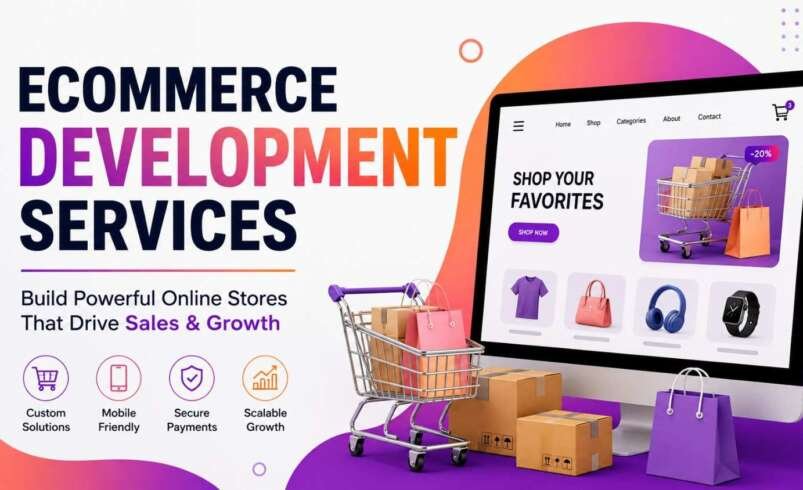
This is where ecommerce development services become valuable. They help businesses create, improve, and manage online stores based on their specific requirements. From developing a new ecommerce website to integrating advanced features, the right development approach can help businesses build a reliable digital shopping platform.
What Are Ecommerce Development Services?
Ecommerce development services involve designing, developing, and maintaining websites or applications that allow businesses to sell products and services online.
These services cover different stages of ecommerce website development, including planning, user interface design, frontend and backend development, payment integration, product management, and ongoing maintenance.
Depending on business requirements, an ecommerce website can be built using platforms such as Shopify, WooCommerce, Magento (Adobe Commerce), BigCommerce, or custom development technologies.
For example, a small clothing business may need a straightforward online store with product categories, shopping carts, and secure checkout. In comparison, a large retailer might require advanced inventory management, multiple payment options, customer accounts, and integration with an existing enterprise resource planning (ERP) system.
The development approach should match the business model rather than relying on a one-size-fits-all solution.
Why Businesses Need Professional Ecommerce Development
An online store represents a business in the digital marketplace. Its functionality and performance influence how customers interact with products and complete purchases.
Professional ecommerce development helps businesses address several important requirements.
1. Better Shopping Experience
Customers want to find products quickly and complete purchases without unnecessary steps. Complicated navigation, confusing product pages, and lengthy checkout processes can discourage potential buyers.
A properly developed ecommerce website makes it easier for visitors to browse categories, compare products, understand pricing, and complete orders.
Features such as product filters, search functionality, clear product descriptions, and mobile-friendly layouts can make shopping more convenient.
2. Improved Website Performance
Website speed plays an important role in user experience. Slow-loading pages can frustrate visitors, particularly those browsing through mobile devices or slower internet connections.
Ecommerce development involves optimizing images, managing scripts, improving server performance, and implementing efficient website architecture.
A faster website helps customers navigate the store more comfortably and can also support better technical SEO performance.
3. Secure Online Transactions
Customers need confidence when sharing personal information and making online payments.
An ecommerce website should use HTTPS, secure payment integrations, appropriate access controls, and reliable security practices. Businesses should also follow applicable privacy and payment security requirements.
Working with experienced developers can help identify potential security weaknesses and implement suitable protection measures.
4. Flexibility for Business Growth
A business may start with a limited product range but eventually expand into new categories, locations, or markets.
A scalable ecommerce website should support future requirements without requiring a complete rebuild whenever the business grows.
Choosing the right platform and technical architecture during development makes future improvements easier to manage.
Essential Features of a Successful Ecommerce Website
Every ecommerce business has different requirements, but certain features are important for creating a functional online shopping experience.
Product Management and Search
Product management allows store administrators to add, update, organize, and remove products. A well-structured product catalog should include product images, descriptions, prices, variations, and availability.
Search functionality and product filters help customers find relevant items without browsing every category.
For example, an electronics store can allow customers to filter products by brand, price range, specifications, and product type.
Shopping Cart and Checkout
The shopping cart allows customers to review selected products before placing an order.
A well-designed checkout process should clearly display product details, shipping charges, taxes, available payment methods, and the final order amount.
Offering guest checkout, where appropriate, can also reduce unnecessary steps for customers who do not want to create an account.
Payment Gateway Integration
Payment gateway integration enables customers to pay through supported online payment methods.
Depending on the target market, businesses may offer credit cards, debit cards, digital wallets, bank transfers, or other locally available payment options.
The selected payment provider should support the business’s location, currencies, transaction requirements, and applicable security standards.
Inventory and Order Management
Inventory management helps businesses monitor product availability and avoid selling items that are out of stock.
Order management provides visibility into order placement, processing, shipping, cancellations, and returns.
For businesses handling a large number of orders, connecting the ecommerce store with inventory or warehouse management software can reduce manual work.
Mobile-Friendly Design
Many customers browse and shop using smartphones. Therefore, an ecommerce website should adapt to different screen sizes and provide accessible navigation, readable product information, and convenient checkout functionality.
Responsive design helps maintain a consistent shopping experience across desktops, tablets, and mobile devices.
Choosing the Right Ecommerce Development Platform
Selecting an ecommerce platform is an important decision because it affects website functionality, customization options, maintenance, and future development.
Different platforms serve different business needs.
Shopify
Shopify is a hosted ecommerce platform that allows businesses to create and manage online stores without managing their own website hosting infrastructure.
It offers built-in commerce features, themes, payment integrations, and an app ecosystem. Shopify is particularly useful for businesses that want a managed platform with options for extending store functionality.
WooCommerce
WooCommerce is an ecommerce plugin for WordPress. It provides flexibility for businesses that want to combine online selling with WordPress content management.
Store owners can customize their websites through themes, plugins, and development work. However, hosting, updates, security, and performance require appropriate management.
Magento (Adobe Commerce)
Adobe Commerce supports businesses with more complex ecommerce requirements.
It offers extensive customization and capabilities for managing large product catalogs, multiple storefronts, and advanced commerce operations. Its implementation and maintenance can require greater technical resources.
BigCommerce
BigCommerce is another hosted ecommerce platform that provides built-in selling features, integrations, and customization options.
It can be considered by businesses looking for a managed ecommerce solution with flexibility for different selling requirements.
The best platform depends on factors such as budget, product complexity, customization needs, technical resources, and long-term business goals.
Custom Ecommerce Development vs. Ready-Made Solutions
Businesses generally choose between using an existing ecommerce platform and developing a more customized solution.
Ready-made platforms provide established functionality and can reduce the time required to launch an online store. They are often suitable for businesses with standard ecommerce requirements.
Custom ecommerce development, on the other hand, allows businesses to build features around their specific operations.
For example, a wholesale distributor may need customer-specific pricing, bulk ordering, quotation requests, and different purchasing permissions. These requirements might need custom functionality or specialized integrations beyond a standard store setup.
The decision should be based on actual business needs. Custom development is not automatically better, just as a ready-made platform is not suitable for every situation.
How SEO Supports Ecommerce Website Development
Search engine optimization should be considered during the development process rather than added as an afterthought.
A technically sound ecommerce website makes it easier for search engines to discover and understand its pages.
Important considerations include:
- SEO-friendly URLs: Use clear and descriptive URLs for product and category pages.
- Page titles and descriptions: Write unique metadata that accurately describes each page.
- Structured data: Implement relevant product and breadcrumb structured data where appropriate.
- Website architecture: Organize products into logical categories and maintain useful internal links.
- Image optimization: Use descriptive image filenames and appropriate alternative text.
- Mobile usability: Ensure pages work properly across different screen sizes.
- Page performance: Optimize images, scripts, and other resources to improve loading speed.
For example, an online furniture store can organize products into categories such as sofas, dining tables, beds, and storage furniture. This structure helps customers navigate the store and gives search engines a clearer understanding of its content.
SEO-friendly development creates a stronger foundation for long-term organic visibility.
Integrations That Make Ecommerce Operations Easier
An ecommerce website often needs to communicate with other business systems.
Third-party integrations help connect the online store with tools used for daily operations.
Common integrations include:
CRM systems: Customer relationship management tools help businesses organize customer information, manage interactions, and support sales activities.
ERP software: ERP integrations can connect ecommerce operations with accounting, inventory, purchasing, and other business processes.
Shipping services: Shipping integrations help automate delivery calculations, label generation, and shipment tracking.
Marketing tools: Email marketing platforms and analytics tools help businesses understand customer behavior and manage marketing activities.
Customer support systems: Live chat and helpdesk integrations allow businesses to handle customer questions and service requests more efficiently.
The purpose of these integrations is to reduce disconnected processes and create a more organized business workflow.
How to Choose the Right Ecommerce Development Partner
Choosing an ecommerce development partner requires more than comparing service prices. Businesses should evaluate technical expertise, communication, development processes, and the ability to understand their requirements.
Start by reviewing the company’s experience with ecommerce platforms and technologies relevant to the project.
Look at previous work to understand the types of websites and functionalities the team has developed. Ask how the development process handles project planning, testing, security, and post-launch maintenance.
It is also important to discuss ownership, documentation, third-party licensing, expected deliverables, and ongoing support before starting the project.
A reliable development partner should be able to explain technical decisions in simple language and recommend solutions based on business requirements rather than unnecessary complexity.
Conclusion
Building a successful online store requires careful planning, suitable technology, reliable functionality, and an understanding of customer expectations. A website should not only display products but also support the complete shopping journey, from product discovery to payment and order management.
Professional ecommerce development services help businesses create platforms that address these requirements while allowing room for future improvements. Whether a business chooses Shopify, WooCommerce, Adobe Commerce, BigCommerce, or custom development, the focus should remain on usability, security, performance, and scalability.
By investing in the right development approach, businesses can establish a stronger online presence, improve operational efficiency, and create a shopping experience that supports long-term growth.