


Ask two homeowners in Gurgaon what “luxury interiors” means to them, and you’ll often get two different answers depending on where they live. A Golf Course Road resident and a Sohna Road resident might have similar budgets and similar Pinterest boards, but the homes they’re designing for rarely call for the same approach. The difference isn’t taste. It’s what the property itself allows, and who’s likely to be using it.
Older money, larger footprints
Golf Course Road, along with pockets of DLF Phase 1 through 5, tends to have larger apartments and independent floors built for buyers who’ve often lived in Gurgaon for a decade or more, or who moved from Delhi with an established sense of what their home should feel like. Layouts here are frequently more generous: bigger living rooms, separate formal and family sitting areas, larger master suites.
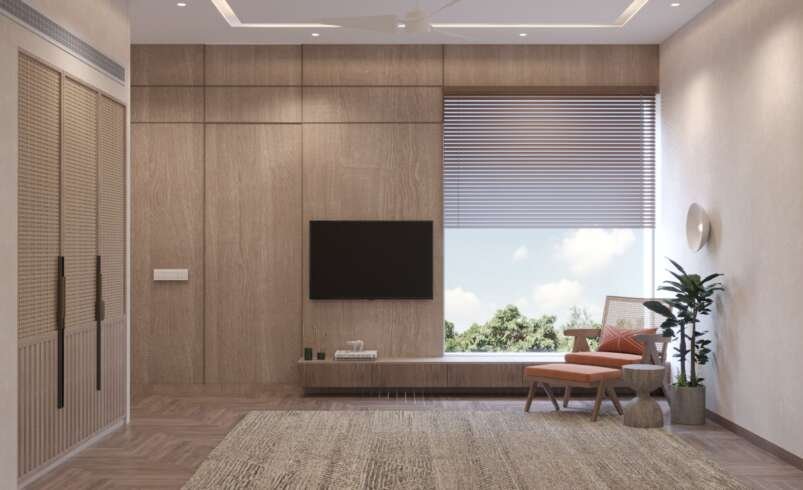
This changes the design conversation in a specific way. With more square footage to work with, the temptation is to fill it, but the better brief usually leans toward restraint — fewer, better pieces, more breathing room between furniture, materials that read as considered rather than abundant. Warmer wood tones, layered lighting instead of a single dramatic fixture, and custom joinery sized to the room rather than maximised for storage tend to suit these homes better than a style pulled directly from a smaller apartment’s mood board.
There’s also more scope for architectural detailing, since larger rooms can absorb a coffered ceiling or a feature wall without feeling busy. In a smaller space, the same detail can overwhelm the room instead of anchoring it.
Newer buyers, compact high-rises
Sohna Road, along with newer developments in Sectors 70 through 108, is largely high-rise apartments bought by a younger demographic — first-time buyers, dual-income households, many with corporate jobs that brought them to Gurgaon rather than families with generational roots in the city. Carpet areas here are typically smaller, and layouts are more standardised across units in the same tower.
The design priorities shift accordingly. Storage efficiency matters more, because there’s less square footage to absorb bulky furniture. Multi-functional pieces — a dining table that extends, a study nook built into a bedroom wall — do more work here than in a larger home where a dedicated study room is simply available. Lighter colour palettes and reflective surfaces help compact rooms feel less enclosed, and furniture is often chosen for how easily it reads as compact without looking sparse.
There’s also a practical difference in how much can be changed structurally. Newer high-rises usually have stricter society rules about civil modifications, so design has to work within fixed walls and services more often than not, which pushes creative solutions toward furniture and layout rather than structural changes.
Why a shared style vocabulary still causes mismatches
Both sets of homeowners might describe what they want using the same words: modern, minimal, warm, luxurious. The mismatch shows up when a design built for one context gets applied to the other. A statement chandelier that anchors a large Golf Course Road living room can dominate a smaller Sohna Road one. A space-saving murphy bed that makes sense in a compact 2BHK would be an odd, unnecessary compromise in a home with a dedicated guest room.
This is also where a firm’s familiarity with both property types matters more than a generic style portfolio. A design that photographs well in a large, empty showroom setting doesn’t automatically translate to a smaller occupied home, and vice versa.
Matching the design to the demographic, not just the square footage
Property type and demographic tend to travel together in Gurgaon, but they don’t fully explain each other. A larger home bought by a younger family with children needs different storage planning than the same size home bought by an older couple. A compact apartment shared by roommates has different practical needs than the same layout used by a couple working from home.
The useful question to ask before finalising any brief isn’t just “what style do I want,” but “who is actually going to live in this space, and what does the property itself allow me to change.” Anyone considering interior designers in Gurgaon is better served starting from that question than from a saved folder of reference images, because the images rarely specify the constraints that will shape whether the look actually works in the home they’re for.
The Interia approaches design briefs by starting with the property and its residents before moving to style choices, which is precisely the sequence that keeps a Golf Course Road design from being force-fit onto a Sohna Road home, or the other way around.
The best interiors aren’t the ones that match a trend. They’re the ones that match the life actually being lived in the space.