
Modern manufacturing requires bonding solutions that are fast, consistent, and suitable for high-volume production. From packaging and woodworking to furniture, bookbinding, mattresses, and product assembly, adhesives have become an important part of many manufacturing processes. Among the available technologies, hot melt adhesive is widely used because of its fast setting characteristics and efficient application.
Superbond has been serving the adhesive industry in India since 1974. With decades of experience in adhesive manufacturing, Superbond provides adhesive solutions for different industries and production requirements, including hot melt, water-based, rubber-based, and other industrial adhesive technologies.
What Is Hot Melt Adhesive?
A hot melt adhesive is generally supplied as a solid thermoplastic adhesive. During application, it is heated until it reaches a suitable molten state and viscosity. The molten adhesive is applied to a substrate, the materials are brought together, and the adhesive develops its bond as it cools and solidifies.
Unlike many liquid adhesive systems, hot melt adhesives typically do not depend on water or solvent evaporation to form the bond. This characteristic can make them particularly useful for fast-moving manufacturing and packaging lines.
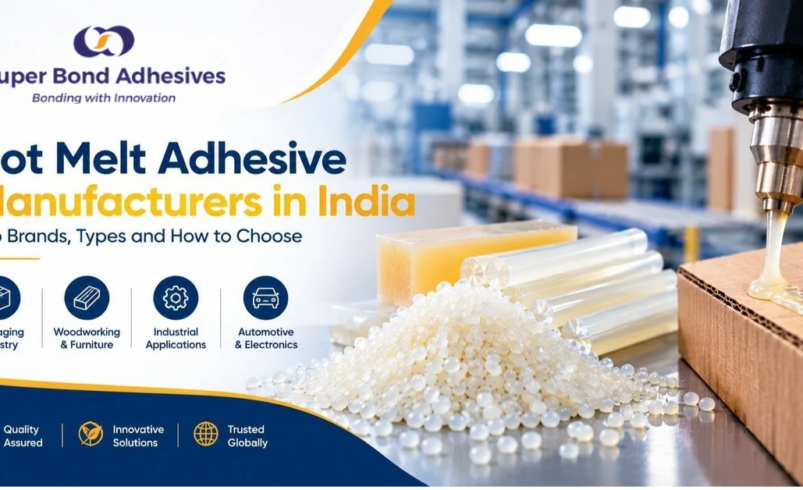
Hot melt adhesives may be supplied in forms such as granules, pellets, blocks, pillows, or sticks, depending on the formulation and application equipment.
How Does Hot Melt Adhesive Work?
The basic hot melt bonding process is relatively straightforward.
First, the adhesive is heated using appropriate hot melt application equipment. Once it reaches the recommended application condition, it is applied to one of the surfaces. The second substrate must then be joined within the adhesive’s available open time.
As the adhesive cools, it solidifies and creates the bond between the materials.
Application temperature, adhesive quantity, open time, substrate temperature, surface condition, and compression can all influence final bonding performance. Manufacturers should therefore follow the technical recommendations for the specific adhesive being used.
Benefits of Hot Melt Adhesive
One of the major advantages of hot melt adhesive is its fast setting capability. This can be valuable for automated production lines where manufacturers need products to move rapidly from one manufacturing stage to another.
Hot melt technology can offer several practical advantages, depending on the formulation and application:
- Fast setting and bonding
- Suitability for high-speed production
- Efficient application using automated equipment
- Good bonding performance on compatible substrates
- No drying stage based on water evaporation
- Clean and controlled application
- Suitability for a variety of industrial processes
The actual performance of a hot melt adhesive depends on its chemistry, substrates, operating conditions, and end-use requirements.
Hot Melt Adhesive for Packaging
Packaging is one of the most established applications for hot melt technology. Packaging lines often operate at high speeds, making rapid adhesive setting an important production requirement.
Hot melt adhesive can be used for applications such as carton and case sealing, tray forming, box manufacturing, and other packaging operations.
A packaging adhesive should be selected according to factors such as the board or substrate, production-line speed, application temperature, open time, compression time, storage conditions, and expected environmental exposure.
Selecting the correct formulation helps manufacturers maintain consistent bonds without unnecessarily slowing production.
Hot Melt Adhesive for Woodworking and Furniture
Adhesives are also important in furniture and woodworking manufacturing. Different processes can require different bonding technologies depending on the materials and machinery involved.
Hot melt solutions can be used in suitable woodworking applications such as edge banding and profile wrapping, subject to the adhesive formulation and manufacturing process.
Woodworking manufacturers should consider the type of board, laminate or edge material, application equipment, operating temperature, production speed, and required resistance when selecting an adhesive.
Superbond provides adhesive technologies for woodworking and furniture applications, including hot melt, water-based, and rubber-based solutions for different production requirements.
Hot Melt Adhesive for Bookbinding
Bookbinding is another application where hot melt technology can provide efficient processing.
The adhesive used for bookbinding needs to create a dependable bond between the pages and spine while meeting the production requirements of the binding process. Properties such as application temperature, setting speed, flexibility, and adhesion can influence the quality of the finished book.
Choosing an appropriate hot melt adhesive can support efficient book production while helping manufacturers maintain consistent binding quality.
Other Industrial Applications
The usefulness of hot melt technology extends beyond packaging, woodworking, and bookbinding. Depending on the specific formulation, it can be considered for applications involving mattresses, paper products, product assembly, filtration, labels, and other manufacturing operations.
However, manufacturers should not assume that one hot melt product will work for every application.
A product designed for packaging, for example, may have different properties from one developed for woodworking or bookbinding. This makes application-specific adhesive selection important.
How to Choose the Right Hot Melt Adhesive
Choosing a hot melt adhesive requires understanding both the manufacturing process and the finished product.
The first consideration should be the substrates being bonded. Paper, coated board, wood-based materials, plastics, fabrics, foams, and laminates can have very different surface properties.
Manufacturers should also evaluate the required application temperature, open time, setting speed, viscosity, production-line speed, application equipment, storage environment, and final service conditions.
Environmental conditions can be especially important. A bond may encounter high or low temperatures during storage and transportation, so the adhesive should be evaluated under conditions representative of its actual use.
Production trials are recommended before implementing an adhesive across large-scale manufacturing.
Why Superbond for Hot Melt Adhesive?
Superbond has been involved in adhesive manufacturing since 1974, building decades of experience in industrial bonding applications.
The company provides adhesive solutions for industries with different materials, machinery, production speeds, and performance requirements. Along with hot melt adhesive, Superbond offers technologies including water-based and rubber-based adhesives for suitable applications.
For manufacturers, choosing an adhesive supplier is not simply about finding a product that sticks two materials together. Consistency, application knowledge, product selection, and compatibility with the manufacturing process are also important.
Superbond focuses on providing adhesive solutions according to specific industrial and application requirements.
Hot Melt Adhesive in Modern Manufacturing
Manufacturers continue to seek faster and more efficient ways of producing high-quality products. Adhesive technology plays an important role in achieving these objectives.
Because hot melt adhesive can provide rapid setting and efficient processing, it can be particularly valuable for high-volume manufacturing where production speed matters.
The right solution, however, should balance speed with adhesion, temperature performance, open time, viscosity, and compatibility with the substrates and machinery.
Conclusion
Hot melt adhesive is a versatile industrial bonding technology used across packaging, woodworking, furniture, bookbinding, paper products, mattresses, and other manufacturing applications.
Its fast setting characteristics and compatibility with automated application systems make it particularly useful for many high-speed production processes. At the same time, selecting the correct formulation is essential for obtaining reliable performance.
With adhesive manufacturing experience dating back to 1974, Superbond provides hot melt and other industrial adhesive solutions for diverse manufacturing requirements in India. By matching the adhesive with the substrate, machinery, operating conditions, and end application, manufacturers can achieve stronger and more efficient bonding processes.