

Introduction
Imagine a customer searching for a local business in their area. They find the company on Google, check the address, visit the website, and then look at a business directory before deciding whether to call. Everything looks straightforward—until they notice that one listing shows different opening hours, another displays an old phone number, and a third uses a slightly different address. Even if the business itself is legitimate and reliable, those small inconsistencies can create doubt.
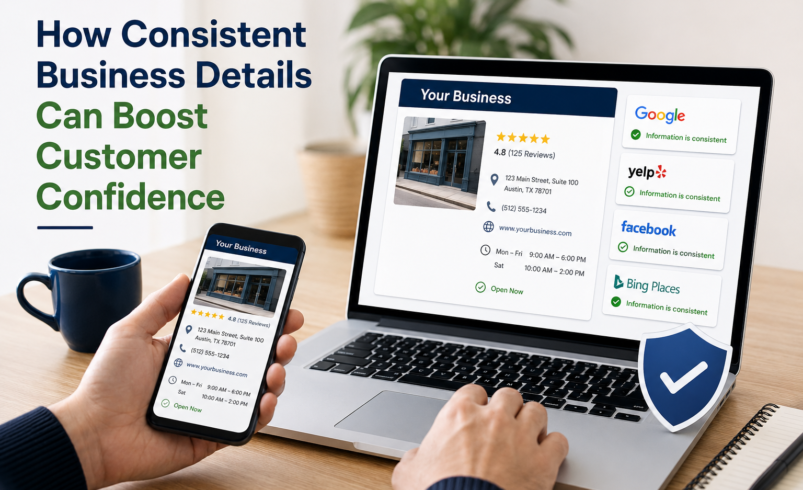
This is why maintaining accurate business listing sites and local business citations is more than a local SEO task. It is an important part of building customer confidence. When people see the same business name, address, phone number, website, hours, and other important details across multiple trusted sources, the business appears organized, legitimate, and dependable.
That matters because local consumers often make decisions quickly. Recent BrightLocal research found that 84% of U.S. consumers had searched for a local business online within the previous three months. The same research found that 72% of consumers typically look at three or fewer businesses before making a decision. In other words, businesses have a relatively small window to make a trustworthy first impression.
Consistency helps make that first impression stronger.
It does not guarantee a customer will choose you, of course. Reviews, pricing, proximity, service quality, reputation, website experience, and many other factors matter. But accurate business information removes unnecessary friction. Instead of wondering whether a business is still operating, whether the listed phone number is correct, or whether the location is accurate, customers can focus on what really matters: whether the business is right for them.
Why Accurate Business Information Matters
Business information may seem simple, but customers use it to answer practical questions before contacting a company.
Where are you located?
When are you open?
How can I reach you?
Do you provide the service I need?
Is this the same business I saw somewhere else?
If customers cannot easily find consistent answers, uncertainty grows.
A recent BrightLocal study found that 56% of consumers often or always check whether business information is correct and matches other online mentions. It also found that 85% consider contact information important when researching a local business.
These findings highlight something business owners sometimes overlook: customers are not simply looking for a business name. They are verifying information.
That verification process can happen across Google Search, Google Maps, social media, review websites, business directories, industry-specific websites, Apple Maps, and other platforms. A customer may never consciously think, “This business has inconsistent citations,” but they can still notice when something feels wrong.
For example, suppose a restaurant’s Google profile says it closes at 10 p.m., while another directory says 9 p.m. A customer planning a late dinner may hesitate to visit. A home service company with an outdated phone number may lose a potential lead before realizing the customer ever tried to call.
The problem is not always that the business is bad. Sometimes the information is simply outdated.
But customers do not always know the difference.
Accurate information builds confidence quietly. Inaccurate information creates doubt just as quietly.
What Are Business Details and Local Citations?
A business citation is a mention of a business’s key information on another website or online platform. Traditionally, citations have focused on essential details such as the business name, address, and phone number, often referred to as NAP information.
Modern local search profiles can contain much more than NAP data. Depending on the platform, customers may also see:
- Business category
- Website address
- Opening and closing hours
- Holiday hours
- Services
- Products
- Photos
- Reviews
- Service areas
- Booking information
- Social media profiles
- Attributes and amenities
This is why businesses should think beyond simply creating directory profiles. The goal is to create a consistent digital footprint that gives customers reliable information wherever they discover the company.
Businesses can use resources such as business listing sites and local business citations to identify relevant directories and citation opportunities, while prioritizing reputable and genuinely useful platforms rather than creating profiles everywhere without a strategy.
Consistency Reduces Customer Doubt
Trust is often built through small signals.
A professional website is one signal.
Positive reviews are another.
Clear pricing can be another.
Accurate contact information is another.
When these signals agree with one another, customers have fewer reasons to question the business.
Consider a customer looking for an HVAC company. They discover a business on Google, then visit its website. The Google listing shows the same phone number, service area, address, and operating hours as the website. They then find the company on another trusted directory and see the same information.
Nothing dramatic happened.
Yet that consistency makes the business feel established.
Now imagine the opposite. Google shows one phone number. The website shows another. A directory has an old address. One profile says the company operates seven days a week, while another says it is closed on Sundays.
The customer may wonder:
“Which information is correct?”
That question introduces friction. And in a competitive local market, customers can easily move to another business.
Customers Often Search Across Multiple Platforms
One of the biggest reasons consistency matters today is that local search no longer happens in one place.
Google remains extremely important, but consumers increasingly use multiple channels during their research. BrightLocal’s 2026 consumer search research found that 75% of consumers used more than one channel during their most recent local business search. Google Search was the starting point for 52% of consumers, while Google Maps accounted for another 9%.
This means a business cannot assume that every customer will discover it through its website or Google Business Profile alone.
Someone might discover a company through:
- Google Search
- Google Maps
- Yelp
- Apple Maps
- Industry directories
- Review websites
- Local chamber websites
- AI-powered search tools
- Local blogs
- Community websites
Every additional platform creates another opportunity to build trust—and another place where inaccurate information can cause problems.
This is particularly important for businesses serving specific geographic areas in the United States. A customer in Dallas, for example, may compare several local providers before making a decision. If one company has complete and consistent information while another has confusing or outdated profiles, the first business can appear more dependable even before the customer contacts either company.
Consistency Can Strengthen Your Local SEO Foundation
Customer trust should be the primary reason to maintain accurate business information, but consistency also supports a broader local SEO strategy.
Search engines need to understand who a business is, what it does, and where it operates. Consistent information across reputable sources can make it easier for search engines and other platforms to connect different mentions of the same business.
That does not mean businesses should copy the same information onto hundreds of low-quality directories simply for the sake of creating citations.
Quality matters.
A better approach is to prioritize relevant, trusted, and useful platforms. For example, a healthcare provider may benefit from healthcare directories and local organizations. A restaurant may need accurate information on food and review platforms. A contractor may benefit from industry directories, local associations, and service-related platforms.
The objective is not quantity for its own sake.
The objective is clarity.
Inaccurate Information Can Create Real Customer Problems
Incorrect listings are not merely an SEO inconvenience. They can directly affect customer experiences.
BrightLocal’s Local Citations Trust Report found that 71% of consumers had experienced a negative situation caused by incorrect local business information online. The research reported that 36% had called an incorrect business number, 24% had arrived too early or too late because of incorrect opening hours, and 22% had visited the wrong location because of an inaccurate address.
These are real-world consequences.
Imagine driving across town because a directory displays an old address. Or calling a phone number that now belongs to someone else. Or arriving at a business at 7:30 p.m. only to discover that its actual closing time is 7 p.m.
Even if the mistake originated on a third-party platform, the customer may still associate the frustration with the business.
That is why citation management should be treated as part of customer experience management.
Consistent Details Make a Business Look More Professional
Professionalism is not only about logos, website design, or polished advertising.
It also appears in the details.
A business that regularly updates its profiles communicates that it pays attention. Accurate hours suggest organization. A current phone number suggests accessibility. A consistent address suggests stability. Updated services suggest that the business is actively maintaining its public presence.
These impressions may be subtle, but they can influence decisions.
BrightLocal’s 2026 research found that complete listing information was important to 34% of consumers during the research stage, while 44% considered the business address or proximity and 38% considered star ratings.
This shows why businesses should not focus exclusively on rankings.
Getting visibility is only part of the challenge.
Once customers see your listing, the information needs to give them a reason to continue.
Reviews and Consistent Business Information Work Together
Business information and reviews should not be treated as completely separate parts of local marketing.
Customers often use both.
BrightLocal’s 2025 Local Consumer Review Survey found that 74% of consumers use two or more websites when reading reviews before choosing a local business. The study also found that consumers increasingly look for detailed, objective information rather than relying solely on star ratings.
This creates an important opportunity.
Suppose your business has excellent reviews, but one directory lists an outdated address. A customer might question whether the reviews refer to the same location.
Now consider a business with consistent contact information, current photos, accurate hours, and detailed customer reviews across several relevant platforms. The overall digital presence becomes easier to understand.
Consistency supports credibility.
Reviews support social proof.
Together, they can create a stronger customer experience.
How to Keep Business Details Consistent
Maintaining accurate information does not have to become an overwhelming project. The key is to create a repeatable process.
1. Create a Master Business Information Document
Start with one official source of truth.
Record your:
- Exact business name
- Main address
- Phone number
- Website
- Business description
- Primary category
- Secondary categories
- Opening hours
- Holiday hours
- Service areas
- Main services
- Booking URL
- Social media profiles
Whenever information changes, update this master record first.
It becomes much easier to keep other profiles synchronized when you know exactly what the correct information should be.
2. Audit Your Most Important Listings
You do not necessarily need to review every website on the internet.
Start with platforms that matter most to your customers and industry.
Check Google Business Profile, major mapping services, prominent review platforms, industry directories, local organizations, social media profiles, and important citation sources.
Look for small differences.
A missing suite number, an old phone number, inconsistent business hours, or a slightly different business name can create confusion.
3. Update Changes Quickly
Businesses change.
They move locations.
They change phone numbers.
They adjust operating hours.
They add services.
They rebrand.
They launch new websites.
When these changes happen, update the most important platforms as quickly as possible.
Do not wait several months to correct an old address or phone number.
4. Keep Your Business Name Natural
Businesses sometimes add extra keywords to names on directories because they believe it will improve rankings.
For example, a legitimate company named “Smith Family Dental” should not arbitrarily become “Smith Family Dental Best Dentist in Chicago” across profiles.
Use the real-world business name consistently.
Accuracy and authenticity should come before attempts to manipulate search visibility.
5. Review Seasonal and Holiday Hours
Opening hours are among the easiest details to overlook.
Businesses should pay special attention before:
- Thanksgiving
- Christmas
- New Year’s Day
- Memorial Day
- Independence Day
- Labor Day
- Other federal holidays
- Local events
- Temporary closures
An incorrect holiday schedule can create a poor customer experience even when every other business detail is correct.
What to Do When You Find Conflicting Information
Finding incorrect information can feel frustrating, especially when you did not create the listing yourself.
Start by documenting the problem.
Record:
- The platform where the incorrect information appears.
- What information is wrong.
- What the correct information should be.
- Whether the platform allows you to claim or edit the listing.
- Whether the change requires verification.
Then prioritize the most important listings first.
If an outdated phone number appears on a major platform, correcting it should take priority over a minor directory with little traffic.
Businesses should also monitor for duplicate profiles. Duplicate listings can confuse customers and create unnecessary reputation and management problems.
Think of every online business profile as a storefront window. If customers see different information in each window, they may wonder which one represents the real business.
Consistency Is Especially Important for Multi-Location Businesses
Businesses with multiple locations face a more complicated challenge.
A national brand may have dozens or hundreds of locations across the United States. Each location needs accurate information while still following brand standards.
For multi-location businesses, create location-specific records for:
- Address
- Local phone number
- Opening hours
- Store-specific services
- Local landing page
- Photos
- Directions
- Service areas
- Holiday hours
Do not accidentally mix information between locations.
For example, a customer searching for a Chicago location should not see the phone number or opening hours belonging to a Dallas branch.
Each location should have a clear and accurate digital identity while remaining connected to the overall brand.
Consistency Builds Confidence Before the First Conversation
One of the most powerful benefits of accurate business information is that it can build trust before a customer ever calls, emails, or walks through the door.
Think about how much happens before a customer contacts a local company.
They may search the business name.
Read reviews.
Check the address.
Look at photos.
Compare opening hours.
Visit the website.
Check another directory.
Look at social media.
Then finally decide whether to contact the business.
Every step is an opportunity to reassure the customer.
A consistent digital presence helps make that process easier.
It tells customers, without explicitly saying it, “This information is current. This business is active. You can reach us. You can find us.”
That is a valuable form of customer confidence.
A Simple Local Business Consistency Checklist
Businesses can use the following checklist as part of a monthly or quarterly local SEO routine:
- Verify the official business name.
- Check the primary phone number.
- Confirm the complete physical address.
- Review website URLs.
- Confirm opening and closing hours.
- Update holiday hours.
- Check business categories.
- Review service descriptions.
- Remove or resolve duplicate listings.
- Update business photos where appropriate.
- Check major review platforms.
- Review social media business information.
- Verify map listings.
- Check important industry directories.
- Look for outdated addresses or phone numbers.
- Record every major business-information change.
For larger organizations, this process can be managed through a centralized local SEO or listings management workflow.
Why This Matters for Long-Term Reputation
Customer confidence is not built from one marketing campaign.
It is built through repeated experiences.
A customer sees your business online today. Another person finds you next week. Someone else searches for you three months from now. If your information remains accurate throughout that period, your business consistently presents itself as reliable.
That consistency becomes especially valuable as consumers use more search channels.
BrightLocal’s recent research shows that consumers increasingly move between Google, Maps, social media, review platforms, and AI tools while researching local businesses.
As the number of discovery channels grows, maintaining accurate foundational information becomes even more important.
Businesses cannot completely control what every third-party website says about them. But they can actively manage their core profiles, correct errors when possible, and ensure their official information is clear and consistent.
Final Thoughts
Customer confidence is often influenced by details that businesses consider routine.
The correct phone number.
The right address.
Accurate opening hours.
A consistent business name.
A current website.
Clear service information.
These details may not seem as exciting as a new advertising campaign or a viral social media post, but they are foundational to a trustworthy online presence.
For U.S. businesses competing in local markets, consistency can help customers move through the decision-making process with less uncertainty. It can support local SEO, reinforce professionalism, improve the customer experience, and make it easier for people to verify that they have found the right business.
The most important takeaway is simple: do not make customers work to figure out who you are, where you are, or how to reach you.
When your business information is accurate wherever customers find you, your digital presence becomes easier to understand—and easier to trust.
Frequently Asked Questions
1. What are local business citations?
Local business citations are online mentions of a business’s key information, such as its name, address, phone number, website, and other business details. They can appear on directories, mapping platforms, review websites, industry websites, local organizations, and other online resources.
2. Why is consistency important for local businesses?
Consistency helps customers verify that information belongs to the same business. When your name, address, phone number, hours, and website match across important platforms, customers have fewer reasons to question whether the information is accurate.
3. Can inconsistent business information hurt local SEO?
Inconsistent information can make it harder for search engines and customers to confidently connect different online mentions of a business. While local rankings depend on many factors, maintaining accurate and consistent information is an important part of a healthy local SEO foundation.
4. How often should a business audit its online listings?
A practical approach is to review important listings at least quarterly and whenever major business information changes. Businesses in industries with frequent changes, multiple locations, or seasonal hours may benefit from checking their profiles more frequently.
5. What business information should companies keep consistent?
At minimum, businesses should keep their official business name, address, phone number, website, business category, opening hours, and major service information accurate. Multi-location businesses should also verify that each location has its own correct address, phone number, hours, and local landing page.