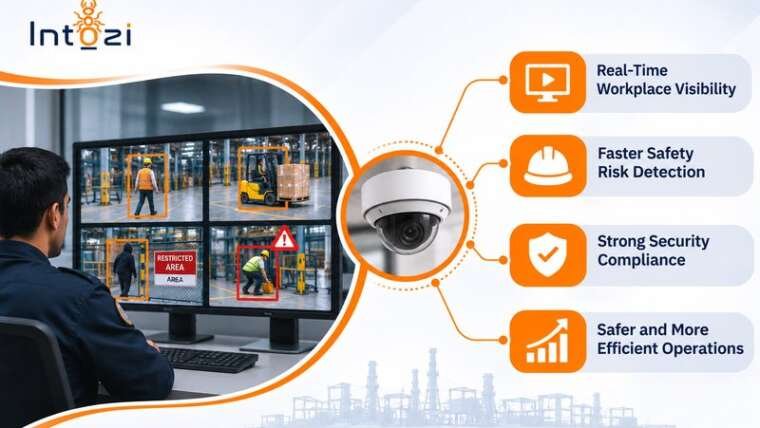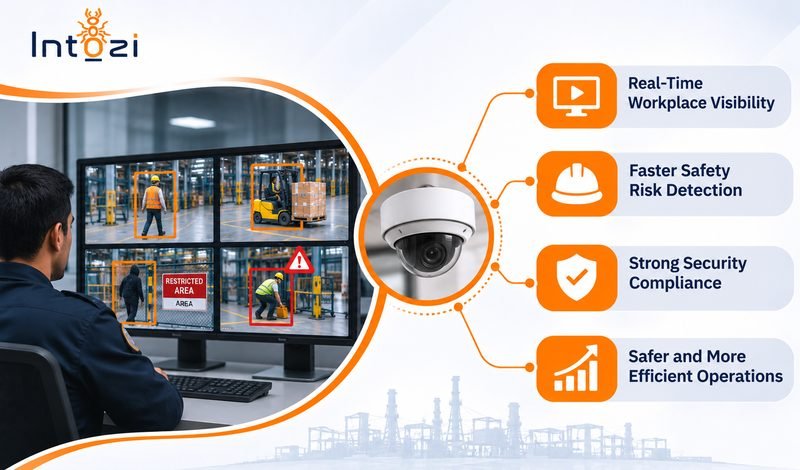

Workplace safety and security are essential for maintaining reliable business operations, protecting employees, and reducing operational risks. In factories, warehouses, offices, and other large facilities, incidents can develop quickly and may go unnoticed when monitoring depends entirely on manual supervision. A well-configured real-time safety and security monitoring system helps businesses gain better visibility into workplace activities, identify potential risks, and respond to situations that require attention.
Traditional CCTV systems provide continuous video footage, but reviewing multiple camera feeds manually can be challenging. AI-powered video analytics adds another layer of intelligence by analysing video streams for configured activities, events, and safety-related conditions. This helps organisations move beyond passive observation towards more informed safety and security management.
How Real-Time Monitoring Improves Workplace Safety and Security
Workplaces involve different types of risks, including unsafe employee activities, unauthorised access, equipment-related hazards, and unexpected incidents. Monitoring these activities across multiple locations can be difficult without appropriate systems.
A real-time safety and security monitoring approach helps businesses observe important workplace areas and identify events that may require investigation or intervention.
It can support:
- Monitoring employee and visitor movement in designated areas.
- Identifying configured safety violations and unsafe activities.
- Detecting unauthorised entry into restricted zones.
- Observing unusual activity around critical infrastructure.
- Highlighting incidents for faster review and response.
- Maintaining recorded footage for investigation and compliance reviews.
For example, in a manufacturing facility, monitoring systems can help identify when a worker enters a restricted operational area or when an activity covered by configured safety rules occurs. Supervisors can then review the event and take appropriate action.
How an AI-Based Surveillance System Strengthens Workplace Security
Traditional surveillance systems depend heavily on human operators to observe camera feeds and identify suspicious activity. As the number of cameras increases, continuous manual monitoring becomes more demanding.
An AI-based surveillance system can analyse compatible camera feeds and identify configured events automatically. Instead of relying only on someone noticing an incident on a screen, the system can highlight relevant activity for security teams.
Common applications include:
- Restricted-area monitoring: Identify entry into designated zones where access is limited.
- Perimeter monitoring: Detect movement across configured boundaries.
- Suspicious activity detection: Highlight selected patterns of movement or activity that may need review.
- Crowd monitoring: Observe crowd density and movement in designated public or workplace areas.
- Incident review: Help teams locate relevant footage and investigate reported events.
These capabilities can strengthen security awareness across facilities. However, AI detections should be treated as alerts for review rather than definitive conclusions about a person’s intentions or behaviour.
Why Businesses Need an Intelligent Security Monitoring System
Large workplaces often have multiple entry points, operational zones, storage areas, and employee movement routes. Monitoring each location separately can make it difficult to understand what is happening across the entire facility.
An intelligent security monitoring system helps bring greater consistency to surveillance by analysing video feeds according to configured detection requirements.
For businesses, this can provide several operational advantages:
- Centralised visibility: Monitor multiple locations through a coordinated surveillance setup.
- Event-based alerts: Highlight detected activities so teams can prioritise relevant camera feeds.
- Faster investigation: Use event information and recorded footage to review incidents.
- Improved monitoring coverage: Support oversight of areas that may be difficult to observe continuously.
- Operational awareness: Help security teams understand recurring activity patterns and potential vulnerabilities.
For example, a logistics facility may need to monitor vehicle movement, restricted storage areas, loading docks, and employee access points. Intelligent video analytics can support different monitoring requirements across these locations, depending on camera coverage and system configuration.
How Smart Surveillance for Workplace Safety Helps Prevent Incidents
Workplace incidents can result from unsafe movement, failure to follow safety procedures, restricted-zone entry, or interactions between people and machinery. Identifying these situations early can help organisations investigate risks before they contribute to more serious consequences.
Smart surveillance for workplace safety uses video analytics to identify selected activities and conditions that may indicate a safety concern.
Depending on the configured applications, monitoring can support:
- Detecting workers entering designated hazardous zones.
- Identifying missing personal protective equipment in monitored areas.
- Monitoring movement around machinery and equipment.
- Observing activity in restricted operational spaces.
- Highlighting selected unsafe behaviours for supervisor review.
For example, in a factory where protective equipment is mandatory, video analytics can identify visible PPE-related conditions and generate alerts when configured requirements appear unmet.
The effectiveness of detection depends on camera positioning, lighting, visibility, object overlap, and analytics configuration. These systems should complement safety training, workplace inspections, and established safety procedures.
How an Accident Detection System Supports Faster Incident Response
When an accident occurs, the time taken to recognise the situation and notify the appropriate team can influence the response. In large facilities, incidents may happen in areas that are not continuously observed by supervisors.
An accident detection system using AI video analytics can help identify selected visual events, such as a person falling or an unusual situation in a monitored zone, depending on the system’s capabilities and configuration.
This can help organisations:
- Highlight potential incidents for immediate review.
- Notify designated personnel when configured events are detected.
- Locate relevant video footage for investigation.
- Understand where and when incidents occur.
- Analyse recurring patterns to support preventive measures.
AI-based accident detection does not guarantee that every incident will be recognised. Camera coverage, occlusion, lighting, and detection thresholds can affect results. Human verification and established emergency response procedures remain essential.
How a Real-Time Threat Detection System Identifies Security Risks
Security threats can involve unauthorised access, unusual activity around sensitive locations, or movement into areas where entry is restricted. Relying only on periodic checks or manual CCTV observation may delay the identification of such events.
A real-time threat detection system can analyse video feeds for configured security-related events and highlight activity that requires attention.
Examples include:
- Unauthorised entry into restricted areas.
- Movement across defined virtual boundaries.
- Unusual activity near sensitive infrastructure.
- Suspicious objects or selected activities, where supported.
- Unexpected crowd formation in designated locations.
These detections can help security teams prioritise their attention and review potential threats. The system’s alerts should be assessed in context because normal activities can sometimes resemble events identified by analytics.
Why Industrial Safety Monitoring Systems Matter for Factories and Warehouses
Factories and warehouses contain machinery, moving vehicles, heavy materials, storage areas, and multiple operational zones. These environments require continuous attention to safety practices and security procedures.
An industrial safety monitoring system can help businesses improve visibility into activities across these locations through compatible cameras and configured analytics.
Relevant monitoring applications may include:
- PPE compliance monitoring.
- Restricted-zone and perimeter monitoring.
- Worker and vehicle movement analysis.
- Detection of selected unsafe activities.
- Monitoring of loading, unloading, and material-handling areas.
- Incident identification and recorded-footage review.
When combined with operational procedures, these insights can help safety managers identify recurring issues and evaluate whether corrective actions are effective.
How an AI Risk Detection System Helps Businesses Manage Operational Risks
Monitoring individual incidents is important, but businesses also need to understand patterns that may indicate recurring risks. Repeated safety violations, frequent restricted-area entry, or recurring congestion around equipment can point towards areas that need operational improvement.
An AI risk detection system can help highlight configured events across monitored locations and provide information for further analysis.
Businesses can use these insights to:
- Identify frequently occurring safety and security events.
- Understand which areas require closer supervision.
- Review recurring access-control violations.
- Investigate patterns in workplace incidents.
- Evaluate the impact of corrective measures over time.
AI analytics supports risk awareness, but it does not independently establish the cause of an incident or replace formal risk assessments. Businesses should combine video insights with incident records, employee feedback, and safety audits.
How AI Surveillance for Public Safety Supports Safer Shared Spaces
Public-facing environments such as transport facilities, commercial complexes, campuses, and large venues often experience high levels of movement. Monitoring these spaces requires visibility into crowd activity, restricted areas, and selected security-related events.
AI surveillance for public safety can support monitoring applications such as crowd-density analysis, perimeter monitoring, and detection of configured events that may require attention.
These capabilities can help authorised teams:
- Identify unusual crowd movement or congestion.
- Monitor access to restricted public areas.
- Review selected security-related events.
- Improve awareness across large monitored spaces.
- Locate relevant footage during incident investigations.
Public safety applications require careful consideration of privacy, lawful deployment, camera coverage, and human oversight. Video analytics should support responsible monitoring practices rather than indiscriminate surveillance.
How Intozi and Ikshana Support Real-Time Safety and Security Monitoring
Effective workplace monitoring requires more than collecting video footage. Businesses need relevant insights that help teams identify potential risks, review incidents, and improve operational awareness. Intozi provides AI video analytics solutions, while Ikshana is its Vision AI platform for supporting configurable video analytics applications. Depending on the deployment environment, these capabilities can support real-time safety and security monitoring, helping organisations strengthen visibility across industrial, commercial, and other operational settings.
Frequently Asked Questions (FAQs)
1. What is real-time safety and security monitoring?
Real-time safety and security monitoring involves observing workplace activities and identifying potential safety or security events as they occur. AI video analytics can help automate the detection of configured events. Intozi provides video analytics solutions through Ikshana, its Vision AI platform.
2. How does an AI-based surveillance system improve workplace security?
An AI-based surveillance system analyses compatible camera feeds to identify configured events such as restricted-area entry, perimeter movement, or selected suspicious activities. This helps security teams prioritise incidents for review. Intozi’s AI video analytics solutions and Ikshana platform support configurable monitoring applications.
3. Can AI video analytics detect workplace accidents?
AI video analytics can be configured to identify certain visible events, such as person-fall scenarios, depending on the system’s capabilities and deployment conditions. Alerts can help supervisors review potential incidents. Intozi and Ikshana support configurable video analytics applications, which should complement established emergency response procedures.
4. What is the difference between traditional CCTV and intelligent security monitoring?
Traditional CCTV primarily records and displays video footage, while intelligent security monitoring uses analytics to identify configured activities and generate relevant alerts. This can reduce the need for continuous manual observation. Intozi provides AI video analytics solutions through its Ikshana Vision AI platform.
5. How does an industrial safety monitoring system help factories?
An industrial safety monitoring system helps factories observe activities in operational areas, identify configured safety violations, and review incidents. AI video analytics can support applications such as PPE detection and restricted-zone monitoring. Intozi and Ikshana provide configurable video analytics capabilities for relevant industrial environments.
6. Can AI surveillance support public safety monitoring?
Yes. AI surveillance can support public safety through applications such as crowd-density monitoring, restricted-area detection, and identification of configured security-related events. These systems require responsible deployment and human oversight. Intozi’s AI video analytics solutions and Ikshana platform can support relevant monitoring applications.