

A properly stored Cohiba cigar should retain enough moisture to remain flexible, burn evenly, and preserve the character of its tobacco. When a cigar becomes too dry, changes can appear in its wrapper, texture, aroma, draw, and smoking characteristics.
Dryness can happen when cigars are exposed to low humidity, excessive heat, poor storage conditions, or prolonged periods outside a properly maintained humidor. Habanos recommends storing its cigars at 16°C to 18°C with 65% to 70% relative humidity.
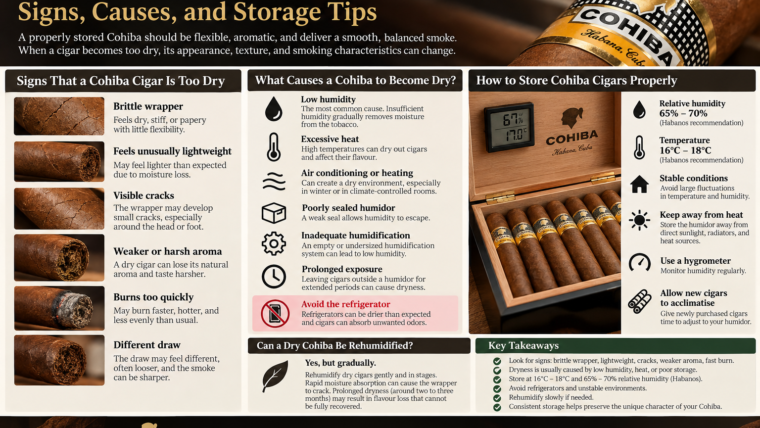
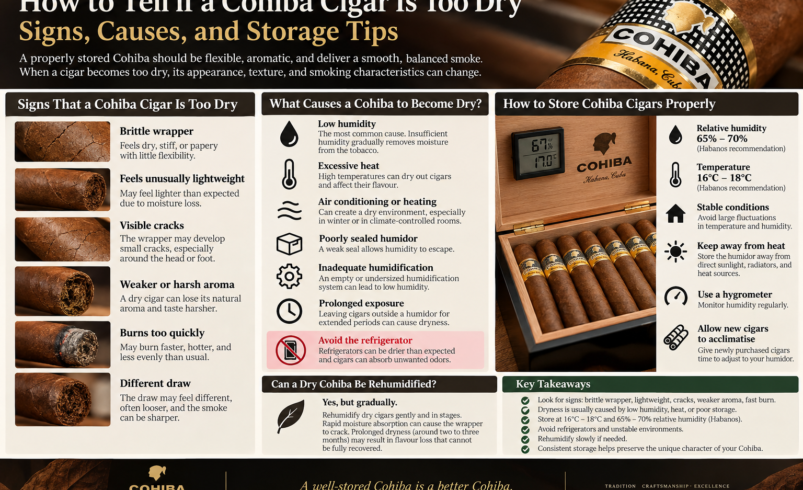
Signs That a Cohiba Cigar Is Too Dry
1. The wrapper feels brittle
One of the easiest signs to notice is a wrapper that feels unusually dry or fragile. A properly conditioned cigar should have some flexibility when handled carefully.
If the wrapper feels stiff, papery, or excessively brittle, the cigar may have lost too much moisture.
Avoid squeezing a dry cigar repeatedly to test it, because excessive handling can damage an already fragile wrapper.
2. The cigar feels unusually lightweight
Moisture contributes to the overall weight and texture of a cigar. If a Cohiba has been stored in a very dry environment for an extended period, it may feel noticeably lighter than expected.
Weight alone is not a definitive test, however. Different cigar sizes naturally have different weights, so it is better considered alongside other signs.
3. The wrapper develops cracks
A severely dried cigar may develop cracks in the wrapper, particularly around the head or foot. The wrapper can become less flexible as moisture leaves the tobacco.
Habanos specifically warns that dry cigars should be rehumidified gradually because introducing moisture too quickly can cause the wrapper to split as the leaves absorb it.
4. The aroma becomes weaker or harsh
A dry cigar may lose some of the aroma associated with properly conditioned tobacco. Habanos notes that excessive dryness can result in a harsher taste and that prolonged dryness can eventually lead to loss of flavour.
This means a cigar that previously had noticeable tobacco, cedar, earth, spice, or other aromatic characteristics may seem flatter or sharper after poor storage.
5. The burn becomes unusually fast
Moisture affects how tobacco burns. A cigar that has become excessively dry can burn more quickly than expected, potentially making the smoking experience hotter and harsher.
An uneven or unusually rapid burn does not automatically mean a cigar is dry, since construction, lighting technique, airflow, and other factors can also affect combustion.
6. The draw feels different
Changes in moisture can also influence the way a cigar draws. If the tobacco has become excessively dry, the draw and burn characteristics may differ from those of a properly conditioned cigar.
Habanos quality-control procedures include checking cigar construction and draw, demonstrating how important these characteristics are to finished cigars.
What Causes a Cohiba to Become Dry?
Several storage problems can contribute to excessive dryness:
- Low relative humidity
- Leaving cigars outside a humidor for extended periods
- Excessive heat
- Frequent temperature fluctuations
- A poorly sealed humidor
- Inadequate humidification
- Storing cigars in unsuitable containers
Temperature is particularly important because humidity changes with temperature. Habanos recommends maintaining a stable environment rather than allowing conditions to fluctuate significantly.
A refrigerator is also not recommended for storing Habanos. According to Habanos, refrigerators can be drier than expected and cigars can absorb unwanted odors from their surroundings.
How to Store Cohiba Cigars Properly
For Habanos, the manufacturer’s recommended storage conditions are 16°C–18°C and 65%–70% relative humidity.
A quality humidor can help maintain these conditions. It should be kept away from direct sunlight, radiators, heating equipment, and other sources of excessive heat.
A digital hygrometer can also help monitor humidity, while regular checks can reveal whether conditions are drifting outside the desired range.
When adding newly purchased cigars to an established collection, Habanos recommends allowing them time to acclimatise. Separating newly introduced cigars from established stock can also be useful while they adjust to the humidor environment.
Can a Dry Cohiba Be Rehumidified?
A cigar that has become dry should not be exposed to a large amount of moisture suddenly.
Habanos recommends rehumidifying dry cigars gently and in stages. Rapid moisture absorption can cause the wrapper to crack or burst.
The condition and duration of the dryness also matter. Habanos states that after approximately two or three months of excessive dryness, a cigar may begin losing flavour that cannot necessarily be recovered.
For valuable or older Cohiba cigars, gradual restoration under controlled conditions is preferable to attempting to correct dryness quickly.
Dryness vs. Normal Aging
It is important to distinguish between aging and dehydration.
Properly aged Habanos are maintained under controlled temperature and humidity conditions. During aging, the filler, binder, and wrapper can gradually develop while the cigar retains appropriate moisture.
A cigar becoming dry is different. Excessive moisture loss can cause changes in texture, aroma, flavour, and smoking characteristics.
Therefore, an older Cohiba is not necessarily a dry Cohiba. Age and storage condition are separate factors.
Final Thoughts
The easiest way to identify a dry Cohiba is to look for several signs together: a brittle wrapper, excessive firmness, reduced aroma, cracks, unusually fast burning, and a harsher smoking character.
If a cigar has already become dry, patience is important. Gradual rehumidification is safer than attempting to restore moisture rapidly, particularly when dealing with valuable or delicate cigars.