
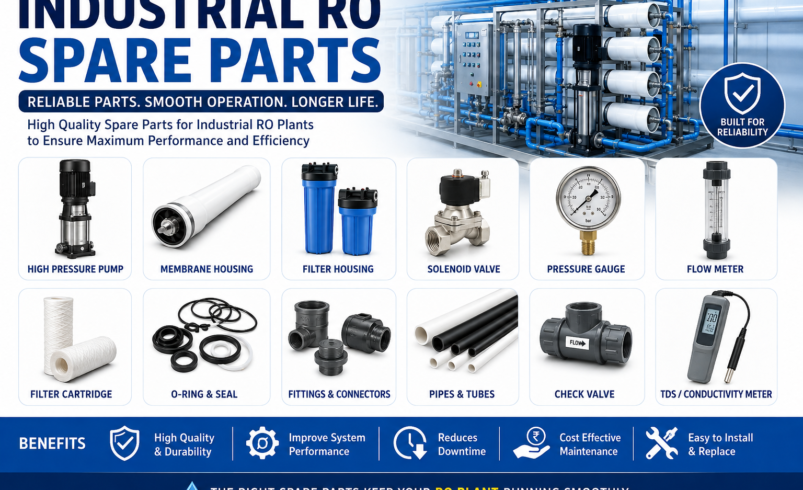

Industrial RO Spare Parts are replacement components used for maintaining, repairing, and servicing industrial reverse osmosis water-treatment systems. They can include membrane housings, high-pressure pumps, valves, filter housings, pressure gauges, flow meters, fittings, connectors, switches, and other system-specific components. Selecting compatible spare parts according to the RO plant’s specifications helps support proper operation and maintenance.
Why Industrial RO Spare Parts Matter More Than They Seem
An industrial RO plant is made up of multiple components working together.
The membrane may receive most of the attention because it is central to the reverse osmosis process, but the membrane is only one part of the complete system.
Water must move through pipes, filters, valves, housings, pumps, pressure-control components, and monitoring equipment before the treatment process can operate as intended.
When one supporting component develops a problem, the effect can extend to other parts of the plant.
For example, a problem with a pump can affect pressure.
A pressure problem can affect RO operation.
A damaged fitting can create leakage.
A faulty valve can interfere with water flow.
A worn filter housing can create maintenance and filtration concerns.
This is why Industrial RO Parts should be considered part of an overall maintenance strategy rather than simply products purchased after a breakdown.
Understanding the Industrial RO Spare Parts Ecosystem
Industrial RO systems vary considerably in design and capacity.
A small commercial system will not necessarily use the same components as a large industrial water-treatment plant.
The required spare parts can depend on:
- Plant capacity
- Membrane configuration
- Operating pressure
- Water source
- Pre-treatment arrangement
- Pump specifications
- Piping design
- Automation level
- Manufacturer specifications
- Installation environment
As a result, there is no single universal list of spare parts suitable for every industrial RO plant.
The correct approach is to identify the components installed in a particular system and maintain compatible replacements.
1. RO Membrane Housing
The membrane housing protects the RO membrane and provides the pressure vessel required for the membrane element.
Depending on the system, housings may differ in:
- Membrane size
- Number of elements
- Material
- Pressure rating
- Port configuration
- End-cap design
When replacing a membrane housing, compatibility is essential.
A housing that physically appears similar may not necessarily be suitable for a specific operating pressure or membrane configuration.
For this reason, plant operators should check specifications before ordering replacement housings.
2. High-Pressure Pump
The high-pressure pump is another critical component in many industrial RO systems.
Reverse osmosis requires appropriate pressure to drive water through the membrane.
Pump selection and condition can therefore have a significant impact on system operation.
A pump may require replacement because of:
- Mechanical wear
- Seal problems
- Bearing issues
- Motor problems
- Performance deterioration
- Operational damage
Before replacing a pump, technicians should evaluate the complete system rather than assuming the pump is automatically responsible for every pressure-related issue.
Correct pump specifications are essential.
3. Filter Housings
Pre-treatment plays an important role in protecting the RO membrane.
Industrial systems commonly use different filtration stages before water reaches the RO membrane.
Filter housings hold the relevant filter elements and help maintain the intended filtration arrangement.
A damaged or unsuitable housing can create leakage, installation problems, or other operational concerns.
Maintaining appropriate RO Plant Spare Parts therefore includes paying attention to pre-treatment components rather than focusing only on the membrane stage.
4. Valves and Flow-Control Components
Valves control the movement of water through different sections of an RO plant.
Depending on the system design, an industrial RO installation may include different types of valves for:
- Isolation
- Flow control
- Pressure management
- Cleaning
- Drainage
- Backwashing
- Process switching
A valve that does not operate correctly can affect the system in ways that may initially appear unrelated.
For example, incorrect flow can influence pressure, recovery, or the operation of another stage.
Keeping suitable replacement valves available can help maintenance teams respond more quickly when failures occur.
5. Pressure Gauges
Pressure gauges provide useful information about system operating conditions.
They may be installed at different points throughout the treatment process.
A damaged, inaccurate, or malfunctioning gauge can make troubleshooting more difficult because operators may not have reliable information about actual pressure conditions.
Replacing a faulty gauge is therefore not simply a cosmetic repair.
It restores an important monitoring function.
When selecting a replacement gauge, pressure range, connection size, installation configuration, and application should be considered.
6. Flow Meters
Flow measurement is another important aspect of industrial RO operation.
Flow meters can help operators monitor different streams, depending on system configuration.
Changes in flow may indicate that something within the system deserves investigation.
Possible factors can include:
- Filter condition
- Pressure changes
- Membrane performance
- Valve position
- Pump operation
- Blockages
- Scaling or fouling
A faulty flow meter can make it difficult to interpret what is actually happening.
This makes suitable flow-measurement components valuable Industrial RO Components for maintenance teams.
7. Fittings, Connectors and Tubing
Small components are often overlooked until they fail.
Fittings and connectors may seem inexpensive compared with pumps or membranes, but a poor connection can cause leakage, pressure loss, or installation problems.
Industrial systems can use various:
- Elbows
- Tees
- Adapters
- Unions
- Couplings
- Connectors
- Pipe fittings
Material compatibility and pressure suitability are important when selecting these parts.
Using an unsuitable fitting simply because it looks similar can create avoidable problems.
8. Electrical and Control Components
Modern industrial RO plants may include electrical controls and automation systems.
Depending on the plant design, replacement requirements can include:
- Switches
- Sensors
- Relays
- Contactors
- Solenoid components
- Control accessories
- Electrical protection devices
These components should be selected according to the electrical and control specifications of the existing system.
Improvising with incompatible electrical parts can create operational and safety concerns.
Why Compatibility Is More Important Than Price
Price is naturally an important consideration when purchasing spare parts.
However, choosing an industrial RO component only because it is cheaper can create additional problems.
A spare part should be evaluated for:
Compatibility
Does it match the existing system?
Capacity
Can it handle the required flow or pressure?
Material
Is the material suitable for the application?
Dimensions
Will it fit correctly?
Connection
Does the connection match the existing configuration?
Operating Conditions
Is it appropriate for the temperature, pressure, and water conditions involved?
A component that costs less but fails prematurely may ultimately cost more through downtime and repeated maintenance.
How the Right Spare Parts Can Reduce Downtime
Industrial water treatment is often connected to larger business operations.
If the RO plant stops, the impact may extend beyond the treatment room.
Depending on the application, treated water may be required for:
- Manufacturing
- Process operations
- Boilers
- Cooling systems
- Food processing
- Hospitality
- Institutional applications
- Commercial water supply
This is why maintenance teams often benefit from keeping critical spare parts available.
The objective is not to store every component imaginable.
The objective is to identify the parts whose failure could create significant downtime and plan accordingly.
Building a Practical Industrial RO Spare Parts Inventory
A spare inventory can be divided into different categories.
Frequently Replaced Parts
These may include consumable or service-related components that require periodic replacement.
Critical Components
These are components whose failure could stop major parts of the plant.
Emergency Parts
These are items that may not fail frequently but could be difficult to source quickly.
Routine Accessories
These can include fittings, connectors, seals, and other smaller components required during maintenance.
This classification can help businesses avoid two common problems:
Too little inventory and unnecessary inventory.
Why Spare-Part Records Are Important
A plant should ideally maintain records of its important replacement components.
Useful information can include:
- Part name
- Part number
- Manufacturer
- Specification
- Quantity available
- Installation date
- Replacement date
- Supplier
- Compatible system
- Current stock
- Reorder level
This information can make future purchasing easier.
It also helps technicians avoid ordering the wrong component.
For larger operations, maintaining digital inventory records can make spare management more efficient.
Industrial RO Spare Parts for RO Dealers
RO dealers and service providers have a different requirement from plant operators.
They may work with multiple brands and different plant configurations.
Their inventory therefore needs to be more flexible.
A service company may commonly require:
- Membrane housings
- Pumps
- Valves
- Filter housings
- Pressure gauges
- Flow meters
- Fittings
- Connectors
- Electrical components
- Seals and accessories
However, stocking should be based on actual service history.
If a particular component is frequently requested, keeping it available can improve response time.
Industrial RO Spare Parts for Service Technicians
For technicians, the challenge is often availability.
A customer may need a repair immediately.
If a basic component is unavailable, the technician may have to wait for procurement.
This can extend downtime.
A well-planned service kit can therefore contain commonly required components.
Before visiting a site, technicians can review:
- Previous service records
- System model
- Existing problem
- Installed components
- Likely replacement requirements
This allows them to prepare more effectively.
The Role of Preventive Maintenance
Preventive maintenance does not mean replacing every component before it fails.
Instead, it means monitoring the condition of the system and addressing potential problems at an appropriate time.
Maintenance may include:
- Inspection
- Cleaning
- Testing
- Lubrication where applicable
- Checking connections
- Reviewing pressure
- Checking flow
- Inspecting valves
- Examining pumps
- Replacing worn components
The exact maintenance schedule depends on the plant and manufacturer recommendations.
A properly maintained spare inventory supports this process.
Industrial RO Components Should Be Selected for the Application
There is no universal “best” spare part.
A component suitable for one plant may not be appropriate for another.
For example, pump requirements can differ based on flow and pressure.
Membrane housing requirements can differ based on membrane configuration.
Valve specifications can differ based on application.
Electrical components can differ according to the control system.
Therefore, buyers should provide as much technical information as possible when sourcing Industrial RO Spare Parts.
Common Mistakes When Buying RO Plant Spare Parts
Choosing Only by Appearance
Two components can look almost identical while having different specifications.
Ignoring Pressure Ratings
Industrial RO systems operate under significant pressure. Components must be suitable for the intended application.
Forgetting Dimensions
Incorrect dimensions can create installation problems.
Buying Without Checking the Model
The original model or part number can make sourcing significantly easier.
Focusing Only on Initial Price
A low purchase price does not guarantee good long-term value.
Keeping No Emergency Stock
Critical components may need to be available quickly.
Avoiding these mistakes can make spare-part procurement more efficient.
A Smarter Way to Purchase Industrial RO Spare Parts
Before ordering, collect the relevant technical information.
Step 1: Identify the Component
Know exactly what needs replacement.
Step 2: Check the Existing Part
Look for model numbers, specifications, dimensions, and manufacturer information.
Step 3: Confirm Operating Conditions
Check pressure, flow, temperature, and application.
Step 4: Verify Compatibility
Make sure the replacement is suitable for the existing system.
Step 5: Compare Suppliers
Evaluate availability, quality, specifications, service, and pricing.
Step 6: Maintain Records
Record the replacement for future maintenance.
This process can reduce incorrect purchases and unnecessary delays.
Frequently Asked Questions
What are Industrial RO Spare Parts?
Industrial RO Spare Parts are replacement components used to maintain and repair industrial reverse osmosis systems. They can include pumps, membrane housings, valves, filter housings, gauges, flow meters, fittings, connectors, and other system components.
Which Industrial RO Parts are commonly required?
Common requirements include membrane housings, high-pressure pumps, filter housings, valves, pressure gauges, flow meters, fittings, connectors, and various electrical or control components.
How do I select the right RO Plant Spare Parts?
Check the original component’s model, dimensions, material, connection type, pressure rating, flow requirement, and manufacturer specifications before purchasing.
Are cheaper Industrial RO Spare Parts always better for reducing maintenance costs?
Not necessarily. The lowest initial price may not provide the best overall value. Compatibility, quality, operating life, availability, and system performance should also be considered.
Should an industrial RO plant keep spare parts in stock?
Critical and frequently required components are often worth keeping in stock, particularly when equipment downtime can affect production or business operations.
Can the same spare part be used in every industrial RO system?
No. Industrial RO plants vary in capacity, design, operating pressure, membrane configuration, and component specifications. Spare parts should be selected for the particular system.
Conclusion
Industrial RO Spare Parts may not receive as much attention as membranes or complete RO plants, but they are essential to keeping water-treatment systems operational.
A reliable industrial RO plant depends on many components working together. Pumps create the required operating conditions, housings hold filtration elements, valves control water movement, gauges provide operating information, flow meters support monitoring, and fittings keep the system properly connected.
When these components wear out or fail, the right replacement part can make maintenance faster and more effective.
For plant operators, the best approach is to maintain a planned inventory of critical and frequently required components.
For dealers and service technicians, accurate product identification and compatibility checks are essential.
For buyers, price should be considered alongside specifications, quality, availability, and long-term value.
Ultimately, successful RO maintenance is not only about replacing a failed component.
It is about having the right Industrial RO Spare Parts available before a small component becomes a major operational problem.