

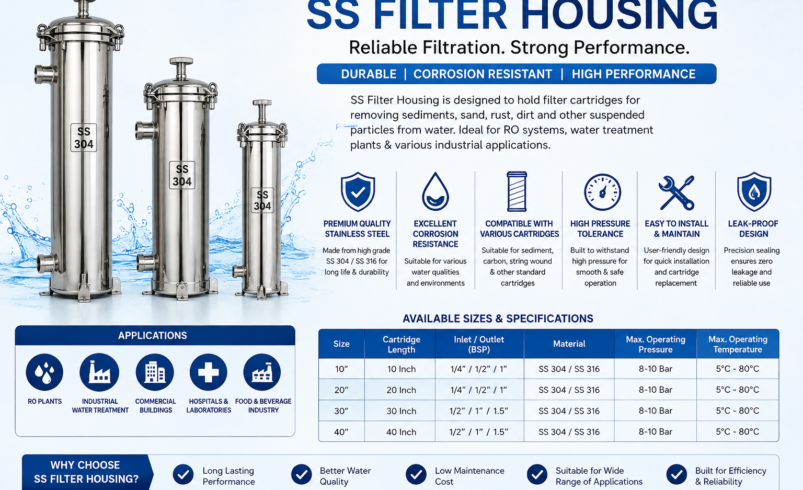

When people discuss a water filtration system, the focus usually goes toward the filter cartridge, RO membrane, pump, or purification technology. But there is another component quietly doing an important job: the SS Filter Housing.
The housing is where the filtration cartridge is installed, and its design affects how water enters, passes through, and exits the filtration stage. In commercial and industrial systems, choosing the housing only by appearance or price can create unnecessary pressure loss, maintenance difficulties, or compatibility problems.
A good SS Filter Housing should be treated as part of the complete filtration design rather than as a simple metal container.
What Makes an SS Filter Housing Different?
An SS Filter Housing is a stainless steel enclosure designed to accommodate a compatible filter cartridge.
Its job is not to remove contaminants by itself. Instead, it creates the controlled environment in which the cartridge performs filtration.
Think of the housing as the framework of the filtration stage.
Water enters through the inlet, reaches the cartridge, passes through the filtration media, and exits through the outlet.
The efficiency of this arrangement depends on how well the housing, cartridge, and operating conditions work together.
This becomes particularly important when the system operates continuously.
Why Housing Design Matters More Than It Looks
Two filter housings may appear almost identical from the outside but perform differently under actual operating conditions.
Small differences in internal design, connection arrangement, cartridge positioning, sealing, and flow path can influence system performance.
For example, if water does not distribute properly around the cartridge, some filtration capacity may not be utilized effectively.
Similarly, an unsuitable housing size can create unnecessary pressure loss.
For this reason, an SS Filter Housing should be selected as part of the complete filtration system.
The Cartridge-Housing Combination
The housing and cartridge should always be considered together.
A high-quality filter cartridge cannot compensate for an incorrectly selected housing.
Before purchasing, check:
- Cartridge length
- Cartridge diameter
- Cartridge configuration
- Micron rating
- Filter media
- Required flow
- Connection size
- Operating pressure
A housing that does not match the cartridge can cause installation problems and may prevent the filtration system from operating as intended.
Where SS Filter Housing Fits Into an RO System
In an RO plant, filtration generally happens in stages.
A typical arrangement may include:
Raw Water → Sediment Filtration → Carbon Filtration → Fine Filtration → RO Membrane
An SS Filter Housing can be used to accommodate cartridges within these pre-treatment stages.
The purpose is to reduce the load placed on downstream equipment.
For example, suitable pre-filtration can help control suspended particles before water reaches the RO membrane.
This makes the filter housing an important supporting component rather than the main purification technology itself.
The Real Reason Stainless Steel Is Preferred
Stainless steel is not selected simply because it looks better.
In appropriate applications, it can provide useful mechanical and operational characteristics such as durability, strength, and resistance to corrosion.
This makes stainless steel attractive for commercial and industrial environments where equipment may operate for long periods.
However, “stainless steel” does not automatically mean the housing is suitable for every application.
The actual grade and construction should match the water chemistry and operating environment.
SS 304 or SS 316?
This is one of the practical questions that comes up when selecting stainless steel equipment.
SS 304 is commonly used for many general-purpose applications.
SS 316 may be considered where additional corrosion resistance is required, depending on the operating conditions.
The correct choice should depend on factors such as:
- Water chemistry
- Chloride exposure
- Chemical exposure
- Temperature
- Pressure
- Application environment
Choosing a material grade without considering these factors can lead to an unsuitable installation.
Flow Rate: The Specification People Often Ignore
A filter housing needs to accommodate the amount of water moving through the system.
This is where flow rate becomes important.
If a filtration system requires a high flow but the housing and cartridge combination is undersized, pressure drop can increase.
This may affect downstream equipment and overall system performance.
Commercial and industrial users should therefore consider peak flow requirements rather than relying only on average consumption.
The right housing should be selected according to the actual operating conditions of the plant.
Pressure Is Another Critical Factor
RO and industrial water-treatment systems can operate under significant pressure.
The filter housing must have an appropriate pressure rating for the application.
Before installation, users should verify:
- Maximum operating pressure
- Expected system pressure
- Connection specifications
- Seal compatibility
- Temperature limits
A housing should never be selected solely based on its physical size.
Its technical specifications need to match the system.
When a Larger Housing Is Actually Useful
Bigger is not automatically better.
A larger housing may be useful when higher flow capacity is required or when a larger cartridge is necessary for the application.
However, oversized equipment can also increase installation costs and occupy more space.
The objective should be to choose a housing that provides the required filtration capacity without unnecessary oversizing.
In other words:
Correct sizing is more valuable than maximum sizing.
The Pressure-Drop Clue
Pressure drop can provide useful information about the condition of a filtration stage.
As a cartridge captures contaminants, resistance to water flow can increase.
If the pressure difference across the filter becomes significantly higher than normal, the cartridge may require replacement or inspection.
This is why pressure monitoring can be valuable in commercial and industrial filtration systems.
Rather than waiting until water flow becomes noticeably poor, operators can use pressure changes as an early maintenance indicator.
Why Filter Replacement Should Not Be Based Only on Time
Many users follow a fixed calendar for replacing cartridges.
While scheduled replacement can be useful, actual cartridge life depends heavily on water quality and usage.
A cartridge treating relatively clean water may last longer than one exposed to high levels of sediment.
Factors affecting cartridge life include:
- Feed-water quality
- Suspended solids
- Water consumption
- Cartridge capacity
- Micron rating
- Operating pressure
Monitoring actual system performance can therefore provide a better indication of when maintenance is required.
Cleaning the SS Filter Housing
The housing itself also needs attention.
When a cartridge is removed, the housing can be inspected and cleaned before installing a new filter.
This helps remove accumulated dirt and deposits.
During maintenance, operators can also inspect:
- Seals
- O-rings
- Connections
- Internal surfaces
- Cartridge supports
- Signs of corrosion
Regular inspection can help identify small problems before they become larger operational issues.
Why Seals and O-Rings Matter
A filter housing may have excellent stainless steel construction, but a damaged seal can still cause problems.
Seals help prevent water from bypassing the intended filtration path.
If an O-ring is damaged, incorrectly positioned, or worn out, leakage or improper sealing can occur.
Therefore, seals should be checked whenever the housing is opened for cartridge replacement.
Using the correct replacement seal is also important.
SS Filter Housing in Industrial Applications
Industrial filtration systems often operate continuously and may handle substantial volumes of water.
In such environments, the housing should be selected according to actual plant conditions.
Potential applications include:
- Industrial RO plants
- Process-water filtration
- Commercial water treatment
- Food and beverage processing
- Institutional water systems
- Pre-treatment systems
- General liquid filtration
Industrial users should pay particular attention to pressure, flow, material compatibility, maintenance access, and cartridge availability.
A Practical Selection Formula
Instead of asking:
“Which SS Filter Housing looks best?”
ask:
“Which housing matches my water, cartridge, flow, pressure, and maintenance requirements?”
This simple change in approach can make equipment selection much more practical.
Consider these five points:
Water: What are the characteristics of the liquid?
Filter: Which cartridge will be installed?
Flow: How much liquid must pass through the system?
Pressure: What operating pressure will the housing experience?
Maintenance: How frequently will the cartridge need to be accessed?
If these five factors are clear, selecting the housing becomes considerably easier.
Common Buying Mistakes
Buying Only on Price
The cheapest housing may not have the specifications required for the application.
Ignoring Cartridge Compatibility
A housing must accommodate the correct cartridge dimensions and configuration.
Forgetting Peak Flow
Average consumption does not always represent the maximum demand.
Choosing Material Without Checking Water Chemistry
The appropriate stainless steel grade depends on operating conditions.
Ignoring Pressure Rating
A housing must be suitable for the system’s operating pressure.
Neglecting Maintenance Access
If cartridge replacement is difficult, routine maintenance can become unnecessarily time-consuming.
SS Filter Housing: More Than Just a Metal Chamber
A well-designed SS Filter Housing supports the filtration cartridge, controls the flow path, and provides a durable enclosure for the filtration stage.
Its value becomes particularly clear in commercial and industrial systems where water quality, continuous operation, and maintenance efficiency matter.
The housing should therefore be selected with the same care given to other major water-treatment components.
The best housing is not necessarily the biggest, most expensive, or most visually impressive one.
It is the one that fits the cartridge, flow rate, pressure, water chemistry, and application correctly.
Final Thoughts
An SS Filter Housing may look like a simple component, but its role in a filtration system is more important than it first appears.
When correctly matched with the filter cartridge and operating conditions, it can provide a durable foundation for commercial RO plants, industrial filtration systems, and other water-treatment applications.
Before making a purchase, look beyond stainless steel construction. Check the material grade, cartridge compatibility, flow capacity, pressure rating, connection size, sealing arrangement, and maintenance requirements.
A filtration system performs as a complete unit. When each component is selected according to the actual application, even the less noticeable components—such as the filter housing—can contribute significantly to a more dependable water-treatment setup.