

A development quote covers design, coding, and testing. It rarely covers everything a live app costs to run. Many founders only discover this after launch, when the first cloud invoice arrives or an operating system update breaks a feature.
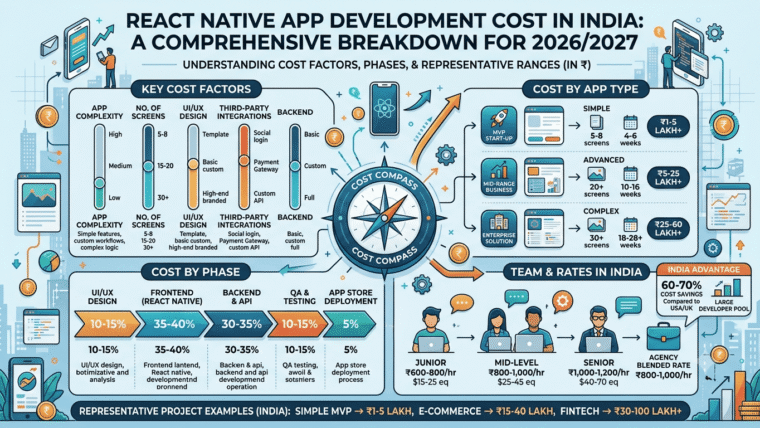
This article walks through the hidden costs of React Native app development and of mobile apps in general, so you can build a realistic budget before you sign a contract. Understanding the full react native app development cost, including what happens after release, is one of the simplest ways to avoid unpleasant surprises.
Why Quotes Leave Things Out
Development agencies price the project they are asked to build. Running costs belong to the product owner, so they often sit outside the proposal. That is not dishonest, but it can leave a gap between what you expect to spend and what you actually spend over the first year.
A good rule of thumb is to add 20 to 30 percent to the development budget for first-year operating costs. The sections below explain where that money goes.
App Store Fees
Apple charges $99 per year for its developer program, and Google charges a one-time $25 fee for a Play Store account. These amounts are small, but they are easy to forget, and an expired Apple membership can remove your app from the store. Assign someone to own renewals and keep the account under a company email address rather than a personal one.
Cloud Hosting
Your app needs servers, databases, and storage. Services such as AWS, Google Cloud, and Azure bill by usage, and costs grow as your user base grows. A new app might spend $50 to $150 per month at launch, while a busy product can spend $500 or more. Set billing alerts early so that a traffic spike or a configuration mistake does not become a large bill.
Third-Party Services
Modern apps rely on other companies’ tools. Payments run through providers such as Stripe. Text messages go through Twilio. Email may use SendGrid, and push notifications often use Firebase. Each has a free tier, but real usage quickly moves you to paid plans. A mid-size app can easily spend $100 to $500 per month on these services combined.
Security Audits and Compliance
If your app handles payments, health data, or personal information, a professional security review is not optional. Audits commonly cost between $2,000 and $15,000, depending on scope. US businesses may also face obligations under laws such as HIPAA for health data or state privacy laws like the CCPA. Building compliance in from the start is cheaper than retrofitting it later.
Analytics and Monitoring
You cannot improve what you cannot see. Tools such as Mixpanel, Amplitude, and Firebase Analytics show how people use the app, where they drop off, and what they ignore. Free tiers help at first, while paid plans for growing apps often cost $50 to $300 per month. Crash reporting and performance monitoring are worth the money too, because they help you fix problems before users leave bad reviews.
Push Notification Platforms
Basic notifications can be sent for free with Firebase Cloud Messaging. Advanced targeting, scheduling, and segmentation through platforms such as OneSignal or Braze can cost anywhere from $9 to $499 per month, depending on audience size. Decide early whether you need these features, because switching providers later takes engineering time.
Maintenance and Bug Fixes
Apps need ongoing care. Bugs appear, libraries release security patches, and devices change. A medium-complexity React Native app commonly needs $500 to $3,000 per month for maintenance, which covers fixes, small updates, monitoring, and dependency upgrades. Another way to plan is to budget 15 to 20 percent of the original build cost per year.
Operating System Updates
Apple and Google release major OS versions every year. Each release can change permissions, interface behavior, or background processing, so your team must test and sometimes update the code. Budget roughly $500 to $2,000 per major release, and avoid putting this off, because stores may require newer SDK versions before they accept updates.
Feature Enhancements
After launch, user feedback creates a steady stream of requests. A major feature commonly costs $3,000 to $20,000 depending on complexity. Keep a prioritized roadmap and set aside a quarterly budget for improvements, so that new features do not compete with urgent maintenance.
A Simple Way to Plan the Full Budget
- List one-time costs: design, development, testing, and store setup.
- List monthly costs: hosting, services, monitoring, and maintenance.
- List yearly costs: store fees, security reviews, and OS upgrade work.
- Add a contingency of 10 to 15 percent.
- Review the numbers every quarter and adjust as usage changes.
This exercise takes an hour, and it often changes the conversation with investors and stakeholders. A budget that includes running costs looks more credible than one that stops at launch day.
Legal, Accounting, and Support Costs
Some costs live outside engineering. A privacy policy and terms of service should be reviewed by a qualified lawyer, particularly if you collect personal data or process payments. Business accounts, insurance, and accounting software add small recurring amounts. Customer support is another one. Even a small app generates questions, and answering them requires either staff time or a help desk tool, which may cost $20 to $100 per month at the start.
Marketing and User Acquisition
A finished app does not find users on its own. App store optimization, content, referral programs, and paid campaigns all require budget and attention. Many founders spend as much on acquiring users in the first year as they spend on building the product. Include a realistic marketing line in your plan, and treat it as part of the cost of launching, not as an optional extra.
Technical Debt and Refactoring
Shortcuts taken to meet a deadline do not disappear. They turn into technical debt, which slows every later change. Planning a small share of each sprint for cleanup, dependency upgrades, and refactoring keeps the codebase healthy. Teams that skip this work often face a costly rebuild after a year or two, which is far more expensive than steady maintenance.
Staff Time on Your Side
Your own team’s time is a real cost. Someone must review designs, test builds, answer developer questions, and manage app store accounts. For a small company that person may be a founder who also has sales and fundraising responsibilities. Include this time in your plan, and appoint a single product owner who can make decisions quickly, because delays in feedback often become delays in delivery.
Working With a Partner Who Plans for the Full Lifecycle
Ask any development partner what happens after launch. Do they offer maintenance plans, monitoring, and a clear process for updates? SpaceToTech is a custom software and mobile app development company that serves clients in the US and other markets, and its team can help you estimate both build and running costs before you commit.
A realistic budget is not a pessimistic one. It simply shows the full picture, so that you can make good decisions while you still have room to adjust.