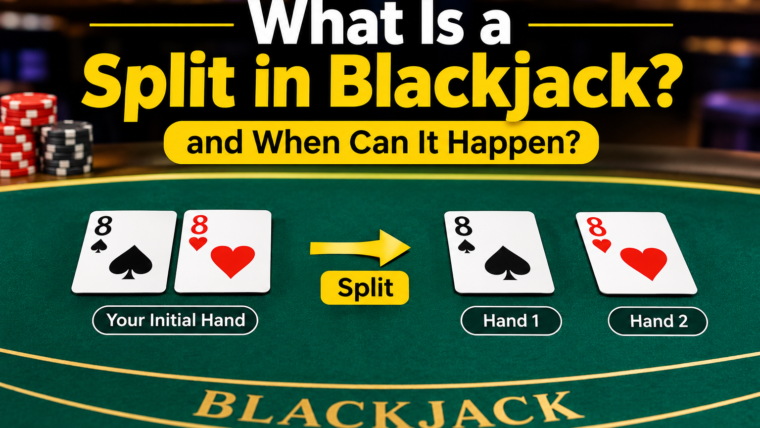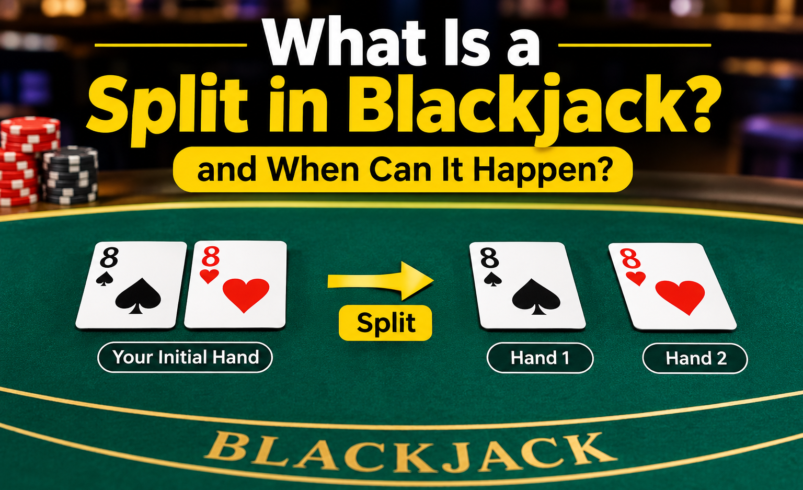

You are playing blackjack, and the dealer gives you two 8s. What would you do next? Most beginners think they have to play both cards together. But there is another option. You may be able to separate them and start two different hands.
This move is called a Split in Blackjack. It is one of the options available to players when their first two cards form a suitable pair.
The idea sounds simple, but a few rules can make it confusing at first. Let’s look at a real example and see what happens when you choose to split.
First, Understand How a Split Works
Think of splitting as turning one hand into two.
Suppose your first two cards are 8 and 8. If the table allows it, you can ask the dealer to separate them. Each card becomes the starting point for a new hand.
Of course, there is an extra cost. You will usually need to place another bet equal to your first bet.
So, if you started with ₹100, you would put another ₹100 on the second hand. The dealer then gives a new card to each 8.
From here, both hands are played separately. You might get a total of 18 on the first hand and 20 on the second. Their results are not linked.
Which Pairs Can You Split?
This is where beginners often have questions. Not every combination of cards qualifies for a split.
In most blackjack games, the first two cards must have the same rank. For example, two 7s or two Queens may qualify.
Take a look at these examples:
| First Two Cards | Can They Usually Be Split? |
| 8 and 8 | Yes |
| 7 and 7 | Yes |
| Queen and Queen | Yes |
| 10 and King | Depends on the table rules |
| 8 and 9 | No |
There is a small detail here. A 10 and a King both have a value of 10, but they are different card ranks. Some tables may allow splitting cards of equal value, while others require the same rank.
That is why checking the rules before starting a game is important.
What Happens After You Choose to Split?
Let’s follow a round to make things clearer.
You place a ₹100 bet and receive two 8s. You decide to split them, and the dealer separates the cards.
Now imagine the following:
- Your first 8 receives a 3. Your hand total is 11.
- Your second 8 receives a 10. Your hand total is 18.
You can now make decisions for each hand based on the options allowed by the game.
Notice something interesting? The same pair has created two very different situations. One hand may need another card, while the other may be ready to stand.
This is exactly how splitting changes a round.
Four Rules That Can Change Your Split
Before using this option, there are a few conditions worth knowing. They are not always the same across blackjack tables.
- You need another bet
This is the first thing to remember. A split usually requires an extra bet equal to your original amount. It is not a free second hand.
- Splitting aces can be different
Aces have special rules in many blackjack games. When two aces are split, players often receive only one additional card for each hand. Taking more cards may not be allowed.
- You may get another chance to split
Imagine splitting two 8s and receiving another 8 on one of your new hands. Some tables allow you to split again. This is known as resplitting. Other tables have limits.
- A 21 after splitting may not count as natural blackjack
This point is easy to miss. A hand that reaches 21 after a split usually does not receive the same payout as a natural blackjack made with the original two cards.
Is Splitting the Same as Doubling Down?
Not at all. Both options may require extra money, which is why people sometimes mix them up.
Here is the difference:
| Split | Double Down |
| Separates a pair into two hands | Keeps the original hand |
| Requires an eligible pair | Can be allowed on other starting totals |
| Usually needs an additional bet | Usually doubles the original bet |
| Each hand is played separately | Usually allows one final card |
For example, splitting two 8s gives you two hands to play. Doubling down keeps your cards together and usually gives you only one more card.
What Should You Check Before Splitting?
There is no need to rush when the split option appears on the screen. Take a moment to understand what the table allows.
Keep these points in mind:
- Check how much extra money the second hand requires.
- Look for restrictions on splitting aces.
- Find out whether the table allows resplitting.
- Read the rules about doubling after a split.
- Remember that two hands can produce two different results.
If you are exploring live card games on KheloExch, knowing these basic terms can make the game easier to follow. Each game may have its own conditions, so the rules shown by the provider should always come first.
And remember, splitting does not promise a win. It simply gives you another hand to play, along with another bet.
Frequently Asked Questions
- Can beginners use the split option in blackjack?
Yes. Beginners can use it when their cards form an eligible pair and the table allows splitting. It helps to understand the extra bet and other conditions first.
- Do I have to split a pair?
No. Splitting is usually optional. You can choose another available action according to the game’s rules.
- Can I split two 10-value cards?
It depends on the table. Two cards with the same rank may qualify, but a 10 and a King may not be treated as a pair.
- What is resplitting in blackjack?
Resplitting means splitting again when one of your new hands receives another eligible pair. Not every table allows it.
- Can I take more cards after splitting aces?
Many tables do not allow this. They usually give one extra card to each ace and then complete those hands.
- Can one split hand win while the other loses?
Yes. Each hand is treated separately, so they can have different results.
- Does splitting increase my original bet?
Yes. You usually need to add another bet equal to your first bet. This means the total amount involved in the round increases.