

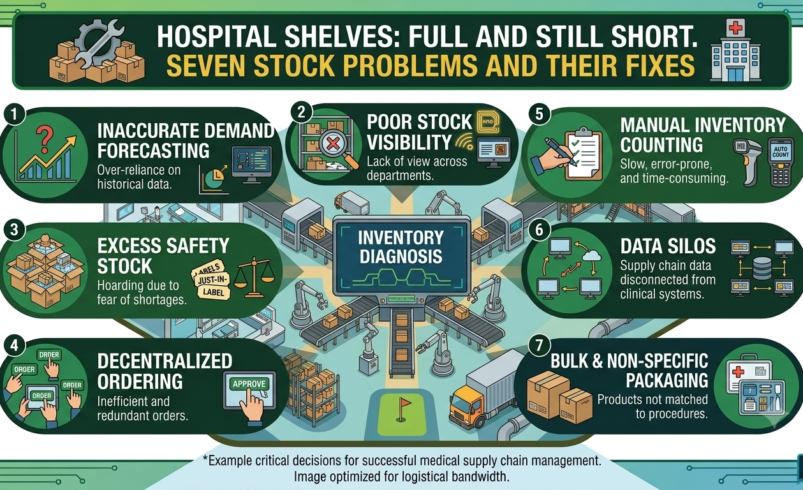

A ward nurse cannot find a syringe size she needs, while the central store holds three months of it and the pharmacy is writing off an expired batch of something else. Nothing is wrong with purchasing volume. The trouble is that stock is held in many places, recorded in several ways, and consumed at rates nobody tracks closely. Understanding the inventory management issues in healthcare supply chains (as supply chain management practitioners often discover) starts with seven recurring problems. Each has a root cause you can test and a fix you can pilot.
Problem one: stock exists but cannot be found
Items sit in central stores, wards, theatres, satellite pharmacies, and ambulances. If each location keeps its own list, the organisation has no single view, and staff order more because they cannot see what is already held.
The root cause is usually missing location-level records. Start by defining every stock location and recording movements between them. Count one high-use category end to end before buying any system, because the discrepancies you find will show you what the system must solve. Barcode scanning at issue and receipt is a practical next step.
Problem two: expiry losses
Short-dated and expired items are one of the clearest signs of poor control. They happen when stock is not rotated, when overbuying outpaces use, or when nobody sees upcoming expiry dates.
Record batch and expiry at receipt, enforce first-expiry-first-out through the system rather than memory, and produce a monthly report of items nearing expiry. Where suppliers allow it, agree exchange or return terms for short-dated stock. Review reorder quantities for slow-moving items, since over-ordering is the usual cause.
Problem three: stockouts of critical items
Not all stockouts are equal. A missing routine consumable is an inconvenience. A missing emergency drug or implant is a clinical risk.
Classify items by criticality and set buffers accordingly. Identify items with a single supplier or long lead time, and keep a documented alternative or substitute approved by clinicians. Track emergency purchases as a measure, because each one shows a planning failure and usually costs more than a routine order. Targets should come from your own baseline and clinical requirements.
Problem four: uneven and unpredictable demand
Seasonal illness, scheduled procedures, outbreaks, and tender supplies all change consumption. Forecasts built on last year’s total ignore these swings.
Use consumption data by location and period, not purchase history alone, and share it with suppliers. Combine a statistical baseline with input from clinical leaders who know about planned changes, such as a new service or a campaign. Review forecast accuracy for critical items and adjust.
Problem five: storage conditions are not controlled
Many healthcare products carry labelled storage ranges, and some, such as vaccines and biologics, need refrigeration throughout. Problems arise at ward refrigerators that nobody monitors at night, deliveries left on a bay, and power cuts without backup. Heat and humidity also affect ambient products in summer and monsoon.
Use continuous recording with alerts to a named person, and define what happens when a reading drifts: containment, notification, and a decision on usability by your quality or pharmacy lead. Do not let the person who holds the stock decide alone whether affected product is still usable. Check backup power and a transfer plan.
Problem six: poor traceability
When a batch is recalled or a device fault appears, the organisation must know where each unit went. That is impossible when issues are recorded by item code alone.
Capture batch or serial numbers at each movement for items that need it, and run a mock recall on a real batch. Time it. Healthcare products are regulated, so your regulatory team should list the standards and documentation that apply, and where patient information is linked to stock records, data protection rules apply too.
Problem seven: returns, wastage, and disposal
Expired medicines, recalled batches, damaged items, and unused devices need segregation, a documented decision, and controlled disposal. Some waste streams, such as biomedical waste, fall under separate rules that your compliance team should confirm.
Record reasons for every return or write-off. Patterns often point upstream: repeated damage suggests a packaging or handling issue, repeated expiry suggests overordering. Use that data to change purchasing and storage practice.
The common thread
Most of these problems come from the same gap: records that do not match the shelf. Fix accuracy first, then rotation, then forecasting. A suggested order is:
- Define locations and count one category.
- Capture batch and expiry at receipt.
- Classify items by criticality and set buffers.
- Monitor storage conditions with named alert owners.
- Run a mock recall.
- Tag returns and write-offs with reasons.
Useful measures include fill rate for critical items, expiry and wastage as a share of stock value, emergency purchases per month, stock accuracy by location, and time to complete a mock trace.
Where an outsourced partner fits
Some hospitals and distributors outsource warehousing, transport, or distribution. That can help if the partner has the capability and records to match, but accountability stays with you. Define in writing who owns storage conditions, deviations, recalls, and complaints. AWL India is an integrated 3PL listing pharma and healthcare logistics among its services, and the seven problems above are a fair way to test it, or any other provider, against your needs.