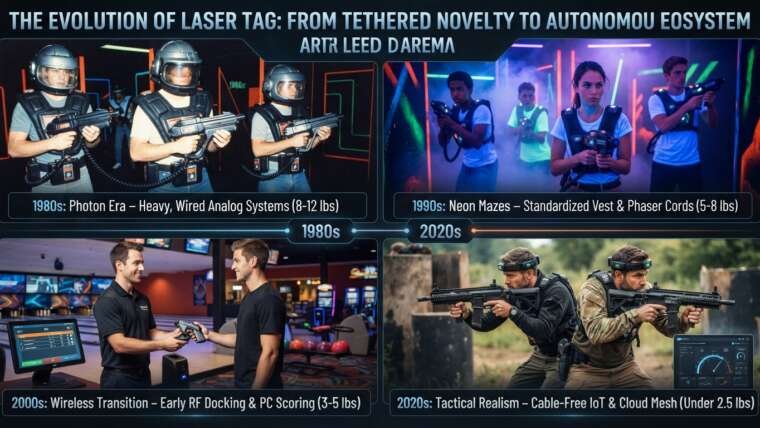

The commercial laser tag industry transformed across four decades, shifting from fragile, cable-tethered arcade novelties into autonomous digital tactical ecosystems. Modern equipment manufacturers like LaserTagSystems represent the culmination of this engineering evolution, integrating microsecond hit validation, wireless mesh networks, and ergonomic designs into professional venue gear.
Early operators in the 1980s managed heavy battery belts, delicate analog sensors, and frequent wiring failures on the arena floor. Today, facility owners run high-throughput games using wireless blasters, cloud-managed software, and durable polymer tagger shells built for continuous commercial operations.
The Dawn of Commercial Tag: From Sci-Fi Inspiration to Photon
The commercial sector owes its origin to science fiction cinema and defense training technologies. Understanding the history of laser tag equipment requires examining how military tactical training merged with public entertainment during the late Cold War:
-
Sci-fi inspiration. George Carter III formulated the concept in 1979 after watching cinematic laser battles and studying the combat simulation hardware used by armed forces. The vision focused on letting civilians experience safe combat games without physical projectiles.
-
The 1984 Dallas launch. Carter opened the world’s first commercial arena in Dallas, Texas, under the brand name Photon. The facility featured catwalks, observation decks, and multi-player team deathmatches.
-
Fragile early hardware. First-generation equipment suffered from heavy helmets, fragile battery belts, and analog wired vest connections that frequently broke during aggressive matches. Players carried cumbersome phasers tethered to bulky body harnesses by thick coiled cords.
These pioneering setups proved that consumers loved tactical electronic competition. However, high maintenance expenses and fragile wiring forced engineers to redesign the equipment for commercial entertainment center adoption.
Military Roots and the Optical Foundation
Every commercial system in operation today shares a direct military MILES tactical heritage. In the late 1970s, the US Army developed the Multiple Integrated Laser Engagement System to train infantry without using live ammunition.
The military version attached pulsed infrared transmitters to real rifles and mounted optical detectors on helmets and harnesses. When a soldier fired blank rounds, the acoustic pop triggered an eye-safe infrared burst that opposing sensors detected instantly.
Commercial inventors borrowed this optical pulse modulation to create civilian attractions. Instead of using blank gunpowder rounds, commercial units adopted electronic triggers, internal speakers, and microcontrollers to calculate hit registration cleanly.
This core engineering principle established the evolution of commercial laser tag. By relying on invisible infrared light rather than physical projectiles, venues created an indoor combat entertainment market with zero bruising and zero ammunition expenses.
The 1990s Boom: Neon Arenas and Family Entertainment Centers
The decade following Photon brought rapid expansion as shopping centers and family entertainment centers integrated combat mazes into their facilities. The indoor neon arena boom turned laser tag from a novelty sport into a standard family attraction alongside bowling and arcade machines.
Engineers replaced the fragile helmets of the 1980s with unified chest packs and dual-sensor shoulder straps. Facilities introduced ultraviolet blacklights, theatrical haze machines, and futuristic soundtrack loops that created an alien combat environment for birthday parties.
During this era, manufacturers standardized two-handed phaser operation. Adding secondary capacitive sensors to the foregrip prevented players from swinging blasters with one hand, dramatically reducing accidental collisions and wall strikes inside darkened mazes.
Scoring also progressed from basic match winners to integrated arcade ticketing. Operators linked laser tag server computers to redemption counters, allowing players to exchange match performance scores for arcade prize tickets and merchandise.
Architectural Evolution Across Four Decades
The technology underpinning laser tag transformed through four distinct development eras. The comparison table below highlights the critical engineering milestones that reshaped operational performance and venue economics.
| Decade | Dominant Tech Architecture | Hardware Weight & Cables | Primary Venue Model |
| 1980s | Analog IR with external battery packs | 8–12 lbs with heavy wired helmets | Standalone specialty arenas (Photon) |
| 1990s | Microcontroller boards and simple display screens | 5–8 lbs with thick vest-to-phaser cords | Blacklight FEC mazes with UV paint |
| 2000s | Wireless docking and basic PC scoring software | 3–5 lbs with early wireless syncing | Multi-attraction bowling and arcade hubs |
| 2020s | Encrypted RF mesh, OTA firmware, and cloud stats | Under 2.5 lbs completely cable-free | Hybrid indoor, outdoor, and mobile operators |
Examining these commercial laser tag technology milestones reveals a steady drop in hardware weight alongside gains in wireless connectivity. Venues transitioned from labor-intensive analog maintenance to streamlined digital fleet diagnostics.
The Wireless Revolution: Cutting the Tether
Between 2010 and 2020, advances in low-power radio microchips initiated the wireless revolution across commercial venues. Removing the heavy umbilical cable between the blaster and the body sensor harness fundamentally changed player movement and equipment durability:
-
Cable elimination. Discarding physical wires eliminated the primary source of equipment failure in high-traffic arenas. Operators no longer lost peak weekend revenue to torn copper leads, broken jack plugs, and short-circuited wiring looms.
-
Real-time telemetry. Modern hardware broadcasts match data across local 2.4 GHz radio frequencies and Sub-GHz channels. Instead of waiting for physical dock syncing after a game, real-time cloud scoring platforms stream player stats to lobby screens instantly.
-
Sunlight-proof outdoor optics. Digital pulse encoding and optical sensor development allowed sensors to reject direct solar infrared interference. This breakthrough freed equipment from darkened mazes and launched the outdoor tactical rental market.
Cutting the physical cord also allowed operators to swap individual components without taking entire suits out of service. If a sensor headband needed sanitation, marshals simply paired a clean band to the blaster via radio in three seconds.
Tactical Realism and Adult Demographic Expansion
As hardware shed weight and gained range, the industry expanded beyond youth birthday parties. The tactical laser tag systems evolution introduced realistic ergonomics, metal-composite receiver bodies, and authentic tactical reload dynamics that appealed to adult players.
Modern tactical games feature objective modes inspired by tactical video games, such as domination points, virtual bomb defusal, and limited ammunition supply boxes. Adult corporate groups, university leagues, and bachelor parties quickly adopted tactical simulation as a pain-free alternative to paintball.
Equipping arenas with modern commercial laser tag hardware gave operators two distinct revenue channels. Venues host youth arcade parties during daylight hours, then switch software presets to tactical simulation for high-spending adult leagues after dark.
Software Modernization and Operator Automation
In early venues, game marshals spent fifteen minutes between matches manually recording scores, resetting phasers, and assigning team vests. This labor-intensive routine limited venues to two matches per hour and inflated payroll expenses.
Modern management software automates the entire match cycle from a central tablet. Operators select game modes, balance team handicaps, and trigger round countdowns with a single screen tap.
Integrated cloud dashboards also monitor battery voltage, trigger switch cycles, and radio signal strength across every blaster in the facility. Automated diagnostics alert technicians to low batteries or degraded sensors before equipment ever reaches a customer.
Frequently Asked Questions About the History of Laser Tag
Who Invented the First Commercial Laser Tag Arena
George Carter III designed the first commercial laser tag system in 1979 and opened the inaugural Photon arena in Dallas, Texas, in March 1984. Carter conceptualized the sport after watching science fiction combat scenes and realizing optical technology could safely track hits between human players.
The Dallas facility featured multi-level catwalks, alien-themed obstacles, and specialized electronic referee towers. Photon expanded into a national franchise network before closing in 1989 due to high hardware upkeep costs.
How Did Military Training Systems Influence Commercial Laser Tag
Commercial systems adopted the optical pulse modulation developed for the US Army’s Multiple Integrated Laser Engagement System (MILES) in the late 1970s. MILES proved that coded infrared bursts could deliver realistic, non-ballistic marksmanship feedback without safety hazards.
Civilian engineers adapted military infrared protocols, replacing blank cartridges with electronic triggers, sound synthesis chips, and eye-safe consumer optics suitable for indoor entertainment centers.
When Did Laser Tag Shift Away from Bulky Vests
The industry began moving away from heavy, cable-tethered vests in the early 2010s with the arrival of ultra-low-power radio transceivers. Wireless sensors allowed manufacturers to mount receiving photodiodes on lightweight fabric headbands and blaster barrels.
This wireless transition cut player gear weight from six pounds down to under two pounds, allowing younger children and corporate adults to play comfortably without heat buildup or physical fatigue.
Why Did Early 1980s Laser Tag Franchises Struggle Financially
First-generation commercial centers struggled with high maintenance expenses and slow group turnaround times. The original analog sensors, bulky lead-acid battery packs, and fragile umbilical cables broke frequently under aggressive daily use.
Repairing cracked casings, fixing frayed wiring, and manually configuring match scores between heats reduced lane throughput. Facilities could not process enough players per hour to offset high commercial lease rates.
The Future Horizon of Commercial Combat Simulation
The evolution of commercial laser tag demonstrates how defense technology transformed into a durable, multi-generational entertainment business. By replacing fragile wired harnesses with robust radio telemetry, manufacturers built an entertainment sector that spans indoor mazes, outdoor tactical parks, and mobile corporate activations.
Modern venues leverage mobile stat tracking, esports matchmaking, and modular equipment fleets to secure high-margin group bookings. Sourcing reliable, battle-tested hardware ensures operators minimize maintenance downtime and deliver immersive tactical experiences for decades to come.