

Real estate marketing starts with what buyers see. Before they read a property description, schedule a showing, or contact an agent, they usually encounter the listing through images. That makes visual presentation one of the most important parts of selling a property online.
For Real Estate Agents, creating high-quality listing images does not always have to mean spending hours editing photos or coordinating expensive staging. New technologies such as virtual staging and AI real estate photography are helping agents create stronger property presentations while reducing the time and effort involved.
When used together as part of a broader marketing strategy, these tools can help agents present properties more effectively, create more marketing content, and deliver a more professional experience to sellers.
Why Property Photography Matters
A listing photo creates an immediate impression of a property. Dark rooms, poor composition, clutter, or inconsistent lighting can make even an attractive home look less appealing online.
Professional photography has traditionally been the preferred solution, but not every agent has access to a professional photographer for every listing. Tight schedules, geographic limitations, and marketing budgets can make traditional photography workflows difficult to manage.
This is where AI real estate photography can provide another option.
AI-powered tools can help improve property images by enhancing lighting, correcting visual issues, improving presentation, and preparing images for different marketing channels. The goal is not to change the property itself but to present its existing features in a cleaner and more appealing way.
What Is AI Real Estate Photography?
AI real estate photography refers to the use of artificial intelligence to enhance, optimize, or transform property photography for real estate marketing.
Instead of manually adjusting every image, agents can use AI-powered software to automate parts of the editing process.
Depending on the tool, this can include improving brightness and exposure, correcting colors, removing distractions, enhancing image quality, and preparing photos for online listings and social media.
For busy Real Estate Agents, the biggest advantage is efficiency.
An agent can start with photographs captured on a smartphone and use AI technology to create more polished marketing images without needing advanced photo-editing skills.
How Virtual Staging Helps Market Vacant Properties
Vacant rooms can be difficult for buyers to visualize. Without furniture, it may be harder to understand the scale of a room or imagine how the space could function.
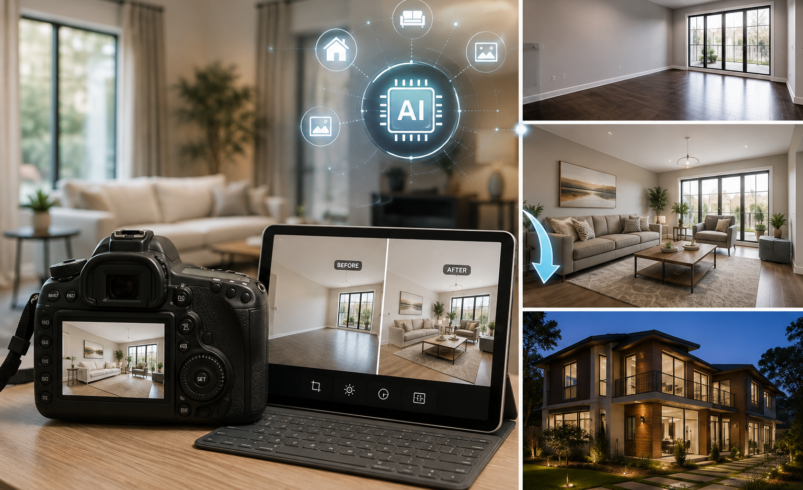
Virtual staging solves this problem by digitally adding furniture and décor to an existing room.
Instead of renting furniture, arranging delivery, coordinating installation, and removing everything after the listing sells, agents can use digital staging to show different design possibilities.
Virtual staging can be particularly useful for vacant homes, investment properties, new construction, and properties where traditional staging is not practical.
It also gives agents flexibility. The same room can potentially be presented in different interior styles depending on the property’s target audience.
As with any digitally enhanced listing image, agents should clearly disclose when furniture or décor has been virtually added.
Virtual Staging vs. Traditional Staging
Traditional staging still has an important role in real estate marketing, particularly for properties where the physical experience of walking through a furnished home is a major selling point.
However, it can also involve significant coordination and expense.
Virtual staging works differently. It focuses on improving the online presentation of a property without physically changing the room.
For some listings, the best strategy may be to combine both approaches. A property can be physically staged in important areas while virtual staging can be used for additional rooms or alternative design concepts.
The right choice depends on the property, seller’s goals, target market, and marketing budget.
AI Real Estate Photography Can Speed Up Listing Preparation
Listing preparation often involves multiple steps.
An agent takes photographs, sends them for editing, waits for the finished images, prepares the listing, creates social media content, and then produces additional marketing materials.
Each step can create delays.
AI real estate photography can shorten parts of this process by allowing agents to enhance images quickly and prepare them for marketing.
For Real Estate Agents managing multiple listings, even small time savings can make a significant difference.
Instead of spending hours on repetitive editing tasks, agents can focus more of their time on client communication, lead generation, showings, negotiations, and other activities that require their expertise.
Combining Photography and Virtual Staging
The real opportunity comes from combining AI real estate photography with virtual staging rather than treating them as separate tasks.
Imagine an agent receives photos of a vacant property taken with a smartphone.
The images can first be improved for lighting and presentation. Empty rooms can then be virtually furnished. The finished images can be used for the MLS, property website, social media, digital advertisements, and other marketing channels.
This creates a more consistent visual experience across the entire listing.
Instead of simply uploading raw photographs, agents can build a marketing-ready image collection that presents the property in its best possible light.
How Walktru Supports Property Marketing
Walktru is designed to help Real Estate Agents create professional property marketing content without relying on a complicated collection of separate tools.
Its AI-powered workflow can help agents transform property photos into polished visual assets while also supporting virtual staging and other listing marketing needs.
For example, an agent can use property photography captured with a phone and turn it into more refined listing imagery. If a room is vacant, virtual staging can help show buyers how the space could look when furnished.
Walktru also supports other property marketing formats, allowing agents to move beyond static listing images and create additional content for their marketing campaigns.
The advantage is a more connected workflow from property photography to listing promotion.
Better Images Can Strengthen a Listing Presentation
Visual marketing is not only important for buyers. It can also influence sellers when they are deciding which agent to hire.
During a listing presentation, an agent can show examples of previous property photography, virtually staged rooms, social media content, listing videos, and other marketing assets.
This gives sellers something tangible to evaluate.
Instead of simply saying, “I will market your property professionally,” the agent can demonstrate what that marketing will look like.
For Real Estate Agents competing for listings, this can help create a stronger first impression and communicate the value of their service.
Use AI to Create More Marketing Content
A strong property shoot can provide much more than the images used on the MLS.
The same visual assets can be adapted into social media posts, carousel graphics, listing reels, email campaigns, property flyers, and other promotional materials.
AI tools can make this repurposing process easier.
For example, an agent can take a collection of enhanced property images and use them across multiple channels instead of creating every marketing asset from scratch.
This allows agents to get more value from every property shoot while maintaining a consistent visual identity.
AI Does Not Replace the Real Estate Agent
There is sometimes a concern that AI will make real estate marketing feel artificial.
The technology should not replace the agent’s judgment.
Real Estate Agents still decide which property features deserve attention, how the home should be positioned, which buyers to target, and what information should be communicated.
AI simply handles some of the production work.
The agent remains responsible for making sure images accurately represent the property and that virtual enhancements are clearly disclosed.
The best results come from combining AI efficiency with human judgment.
Best Practices for Using AI in Real Estate Photography
AI works best when it improves the presentation without creating unrealistic expectations.
Agents should start with clear, well-composed photographs whenever possible. AI can enhance an image, but it cannot completely compensate for a poorly captured photograph.
Virtual staging should also remain realistic. Furniture should fit the room’s proportions, architectural features should remain accurate, and digitally added elements should not mislead potential buyers.
Consistency is another important factor. Images across a single listing should maintain a similar quality, lighting style, and visual presentation.
Most importantly, agents should always follow the disclosure requirements and platform rules that apply to digitally altered or virtually staged property images in their market.
The Future of Real Estate Photography Is More Flexible
Real estate photography is moving toward a more flexible model.
Professional photographers remain valuable, but AI tools are giving agents additional ways to prepare listing content quickly. Virtual staging is making it easier to present vacant properties, while AI image enhancement is reducing repetitive editing work.
The result is a workflow where agents can create more professional marketing content without necessarily adding more complexity.
For smaller teams and independent agents, this can help close the gap between their marketing capabilities and those of larger brokerages with dedicated creative teams.
Final Thoughts
Virtual staging and AI real estate photography are becoming practical tools for modern property marketing.
They can help Real Estate Agents improve listing images, present vacant rooms more effectively, produce more marketing content, and reduce the manual work involved in preparing a property for market.
The key is using AI responsibly. Technology should enhance the property’s presentation, not misrepresent what buyers will actually find.
For agents looking to simplify this process, Walktru provides an AI-powered approach that brings property photo enhancement, virtual staging, listing content, and other marketing capabilities into a more connected workflow.
As online property discovery becomes increasingly visual, agents who can consistently present listings professionally and efficiently will have a stronger opportunity to stand out with both sellers and buyers.